
Simply Top Drawer
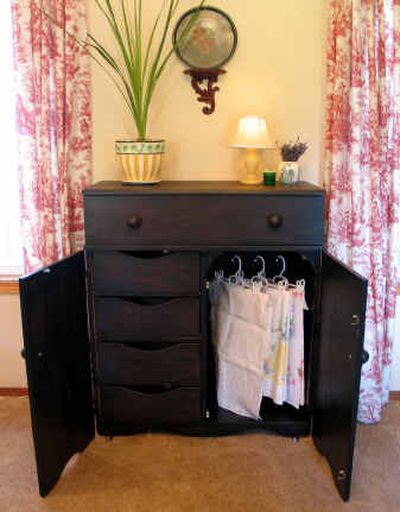
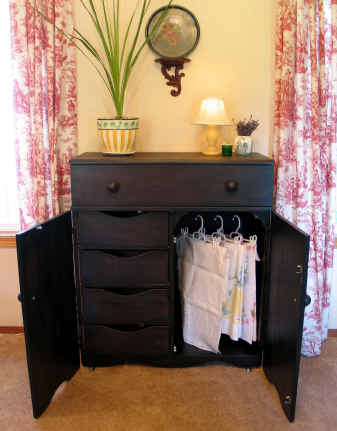
Mother’s little helper is all grown up. With a fresh coat of paint, and put to new use, a 1950s era baby wardrobe moved out of the nursery and into the dining room.
Surrounded by baby strollers, car seats and other outgrown or well-used kid paraphernalia at a church rummage sale, the $20 wardrobe with four drawers on one side and a space to hang clothes on the other – originally made to go in a child’s room – didn’t look like much. But a closer look revealed sturdy solid-wood construction and interesting elements like the notched drawers and large round knobs.
Traces of the original 1950s turquoise peeked through the peeling layers of flat and semigloss white paint. The wood had been gouged and damaged in several spots, but the piece was well built and with a little elbow grease could be useful again.
We decided to turn it into storage for vintage linens. The drawers would hold napkins, tea towels and table runners. Tablecloths could be hung and kept wrinkle-free.
After buying the wardrobe and bringing it home, the first step was to prepare it for painting by removing the knobs and latches, and sanding all surfaces. This was necessary to rough up the glossy paint, so new paint would adhere, as well as to even the surface by removing any rough spots. The damaged wood was repaired with wood filler and allowed to dry.
The knobs were screwed into a piece of cardboard to make them easier to paint. Gouges were filled with wood putty and allowed to dry.
Next, the entire wardrobe, including the interior, was painted flat black. A flat-finish paint was chosen to allow a finishing coat of a contrasting color – in this case red – to be applied with a “dry brush” technique.
The black base coat was rolled on and then smoothed with a brush. (Tip: Start at the top and work down. It’s easier to catch drips that way and you won’t be as likely to get into wet paint.)
After the base coat dried, red latex paint (we used leftover eggshell interior wall paint) was brushed on lightly, using long smooth strokes. (Dry brushing calls for a light hand. Remove excess paint from the brush before you paint.)
After the red paint dried, another light coat of the flat black paint was applied using the same dry-brush technique. This toned down the red leaving subtle red highlights. The same treatment was used on the large wood knobs.
A wood dowel, also painted black, was cut to fit the brackets on the side of the wardrobe that was meant for hangers.
Now, a cast-off relic that once stored baby items has become a handsome serving piece and storage for fine hand-embroidered linens and colorful vintage tablecloths.