
The meaning of ‘Lights’

The rhapsodic hyperbole, the media scrutiny, the fan obsession.
No, we’re not talking about the Boston Red Sox at playoff time. This is Texas high school football, and exaggeration is impossible.
From the big cities to the smallest wind-swept towns, it really is a way of life. H.G. “Buzz” Bissinger captured it with eloquence and evocative detail in his 1990 best seller “Friday Night Lights” – and director Peter Berg does it again in his film of the same name.
It’s easy to over-dramatize the heroism and heartache of a sports movie, but Berg, who adapted Bissinger’s book with screenwriter David Aaron Cohen, resists the urge and goes in the opposite direction.
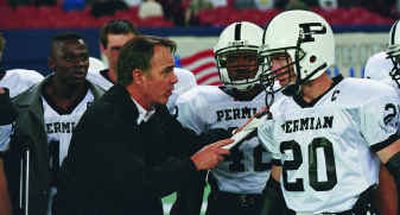
The focus is on Permian High School football in the West Texas city of Odessa, both on the field and in the locker room. The look is stripped down and bleached out, making the already parched landscape of oil fields and scrub brush seem even bleaker, though in a strikingly beautiful way. And the soundtrack is an eclectic mix of old-school rap, rock and punk, including the truly inspired use of The Stooges’ “I Wanna Be Your Dog” during one dramatic second half in the 1988 state playoffs.
There is an awful lot of action, though – the football scenes have a bone-jarring realism thanks to stunt coordinator Allan Graf, a former University of Southern California offensive lineman who also choreographed the plays in “Any Given Sunday” and “Jerry Maguire” – but sometimes at the expense of character development.
For example, the book focused more on Brian Chavez, Permian’s star tight end who went on to Harvard and is now a lawyer in Odessa. Here, he’s a barely fleshed-out supporting character played by “crazy/beautiful” co-star Jay Hernandez.
Bissinger, who happens to be Berg’s second cousin, also spent more time exploring the racial and socio-economic rifts that existed both within Odessa in the late 1980s and between Odessa and rival Midland, a wealthier, whiter town 20 miles east.
But Berg does faithfully depict the be-all, end-all element of high school football in places such as this, where literally every store shuts down on Friday nights and the 20,000 people packing the stadium all have some opinion on how the coach should run the team.
As the under-pressure Coach Gaines, Billy Bob Thornton continues to show he can bring nuance to any role. Thornton doesn’t turn the character into a cliché, barking out orders like a drill sergeant. Instead, he shows the seething anxiety of living under the constant possibility of being fired as well as the genuine desire to develop strong players and even stronger men.
Among the stars on his squad are shy quarterback Mike Winchell (Lucas Black, who played opposite Thornton as a boy in “Sling Blade”), who’s not really sure why he’s playing football, and party-boy tailback Don Billingsley (Garrett Hedlund), who’s living in the shadow of his alcoholic father (Tim McGraw), a star at Permian 20 years earlier. Country music star McGraw gives a surprisingly convincing performance in his film debut.
The role that offers the greatest range is that of Boobie Miles (Derek Luke), the showboating running back who helps the Panthers light up the scoreboard in their first game, only to suffer a serious injury. Luke, the “Antwone Fisher” star, is magnetic at the character’s high point, then appropriately furious and fearful.
His performance vividly conveys how high school football can be more than a religion – it can represent life itself, for better or worse. Berg, as Bissinger did before him, lets us decide for ourselves.