
Huffaker takes on wolves, money, hunter orange
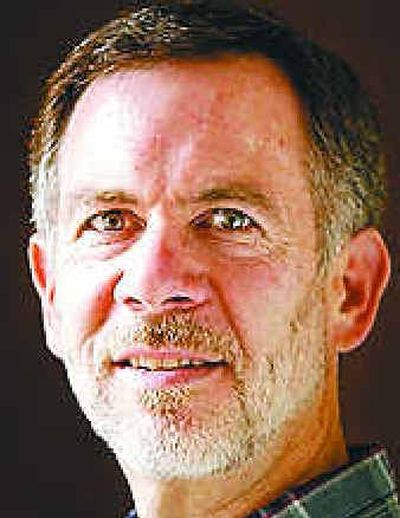

On Tuesday, the last day of the cow elk hunting season, two dozen sportsmen showed up for a breakfast in Coeur d’Alene and a chance to bend the ear of Idaho Fish and Game Department Director Steve Huffaker.
They had questions about issues dear to their hearts and their wallets, and this was a chance to get answers from the top.
“That’s a remarkable turnout, given the timing,” Huffaker said before returning to IFG headquarters in Boise. Indeed, it’s not easy to assemble Fish and Game employees, much less sportsmen, during the prime time to tag an elk.
But predators, license fee increases and hunter access rank as high on a serious sportsman’s priority list as putting meat in the freezer.
“Everybody has questions about wolves,” Huffaker said, and the Coeur d’Alene group was no exception. Some people are concerned about the success of wolf re-introduction while others want to be sure the wolves don’t decimate elk herds and take a bite out of livestock grower livelihoods.
“The short answer is that biologically, they’re doing fine in Idaho and we ought to de-list them (from endangered species protections). Unfortunately, it’s difficult procedurally for the (U.S.) Fish and Wildlife Service to do.”
The department as well as the governor’s office have held the necessary public meetings and worked hard on wolf plans that would enable the state to start managing wolves even in a limited way in the interim before the species is removed from the endangered list.
“But it’s gone nowhere in Washington, D.C.,” he said. “It’s stuck at the (Interior) secretary’s level. They’re a little preoccupied over there lately.
“We’re going to keep working until it’s done,” he said, “so we can manage wolves the way we treat black bears, mountain lions and other game animals.”
License fee increases, however, have moved to Huffaker’s priority list.
Without increases, his department’s plans for managing wildlife, nabbing poachers, improving habitat and increasing hunter access to private lands would have to be curtailed.
In recent years, Idaho has raised non-resident hunting and fishing license fees so that they are higher that most of the 11 western states.
This fee increase proposal, the first in five years, is aimed at residents, who pay less for their licenses than sportsmen in most of the Western states.
The increases range from $1.50 for a resident hunting license — boosting the fee to $13 — to $3.75 for an elk tag, which would bring the cost to $32.25.
Those are hefty increases and Huffaker knows it. “Nobody likes to see a big increase,” he said.
Idaho hunting and fishing license fees have been hiked every seven to 12 years, and when the ax falls it feels sharp.
Huffaker is proposing more moderate increases on a more regular basis but still conditional to public comment and the approval of the Fish and Wildlife Commission and ultimately the Idaho Legislature.
“If sportsmen support it, we think it will pass,” Huffaker said. “We need the money to continue the programs they’ve told us they want.
”Five years ago, gas was $1.60 a gallon; now it’s $2.04,” he said. “This affects us as much as everybody else,” noting that conservation officers in rural Idaho drive 15,000-20,000 miles a year to enforce wildlife laws.
“The cost of helicopter time for big-game counts has gone up from $450 and hour to $540, and we use 200-300 hours of chopper time a year for each of the eight big-game regions.
“The cost of fish food at our hatcheries is up only three cents a pound, but that adds up when you’re feeding a couple million pounds of it.”
Huffaker had plenty more obvious examples, including cost for coordinators for volunteer programs that save the state a bundle. But most sportsmen don’t realize that IFG is a black sheep of sorts in the state capitol.
“All of our funding comes from sportsmen,” he said. “When state employees get a 3 percent pay raise, agencies like the Department of Health and Welfare get an additional 3 percent in their budget from the general fund. Fish and Game gets the same obligation but not the money. We have to eat it out of existing revenue. That’s how we fall behind.”
Hunting and fishing fees are still remarkably cheap compared with other recreation and entertainment, especially when you consider the department has launched a program to improve hunter access.
In just two years, the new Access Yes program has opened or preserved access to nearly 300,000 acres in Idaho. In North Idaho, the program has focused on maintaining public access to corporate timber land.
Hunters are accustomed to using these areas, but times are changing and timber companies are closing or selling some of these prime timberlands, Huffaker said.
“In the future, if people want to hunt on private land, this sort of program has to grow,” he said.
A Panhandle hunter was reported shot and killed, apparently by another hunter, while Huffaker was in the area.
“It’s tragic that people die doing something as fun and as safe as hunting,” he said. “It really is safe.”
Ultimately, much of the responsibility for hunter safety is in the hands of hunters themselves, he said.
Firearms-related hunting accidents could be almost eliminated if hunters followed the muzzle-control safety rules they learn in hunter education courses mandatory for any Idaho hunter born after 1974.
Beyond that, he said, “Keep your gun unloaded and in its case while in a vehicle and wear hunter orange in the woods — those two things would prevent most of the accidents that occur.”
Washington and Montana require hunters to wear fluorescent orange clothing during firearms hunting seasons, but Idaho does not.
“We asked the commission to make rule for wearing hunter orange some years ago in response to some tragic accidents” in which hunters had been shot by partners after being mistaken for game, Huffaker said. “People reacted very strongly and rejected it.
“It’s a good idea to wear hunter orange and it would be a good law. Biologically the eye of a deer or elk doesn’t have the same cones as a human eye, and they don’t see color the way we see it.
“But there’s a social stigma here about wearing hunter orange, sort of like the idea of wearing seat belts 20 when it came up 20 years ago.”
Personally, I’ve just returned from big-game hunting in Montana, where the equivalent of a hunter orange vest was required more than 40 years ago when I lived there and passed my hunter education course.
I’ve been back every year, wearing the colors, and I’ve never had a season in which I didn’t bag a deer, elk or pronghorn.
I’ll never forget the conclusion of a friend who hunted in Washington with me years ago and was a little put off at first when I insisted that he wear a hunter orange vest and hat.
After bagging a whitetail buck at close range, he admitted that he felt more comfortable in the woods when he started hearing shots and that he appreciated how easy it was to spot me as I took a stand on the opposite side of the drainage.
“If I needed a rescue, I’d be easy to spot,” he joked.
Growing more serious, he said, “There’s no way a hunter wearing fluorescent orange could be mistaken for game and shot.
“It wouldn’t be an accident. It would have to be murder.”