
Workforce Training Center marks 10 years at Riverbend
The North Idaho College Workforce Training Center will celebrate a milestone in training and education on Sunday.
The center will reach a decade of instruction at the extension building in the Riverbend Commerce Park in Post Falls.
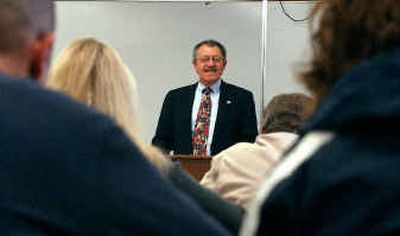
“We’re right where we need to be 10 years later with a much larger portfolio,” said Robert Ketchum, director and vice president of instruction.
The fall course book is 49 pages of classes compared to 15 pages in 1994. The center offers a range of classes for businesses, such as hiring techniques, sales skills and leadership. Other classes are offered for general self development and recreation.
Enrollment has continued to grow since it started in 1990, aside from a dip following the terrorist attacks on Sept. 11, 2001. This year, 9,305 people enrolled for training and community education classes.
Ketchum said the program is playing a larger role at NIC because of its hand in training adults and continuing education.
Before moving to Post Falls, the Workforce Training Center was part of the NIC campus, with only one room dedicated to work-force training efforts. It offered courses similar to those offered now and many classes were gaining in popularity, he said.
“All one had to do was look at what was doing well at other community colleges and know that was possible here,” Ketchum said.
Finding a building to accommodate growth was a big step, and the need became urgent when the center got the opportunity to train 500 employees to build furniture for Harper’s, now Flexcel, in Post Falls, he said.
“It reinforced the argument that the college needed a permanent home to do this sort of work,” Ketchum said.
Bob Potter, former president of Jobs Plus, worked with Harper’s to bring the company to Post Falls. At the time, Oregon, Utah and Washington were competing for the furniture manufacturer, but the available training was the leverage needed to seal the deal.
“Every time we recruit a company, that’s one of the things we list as an asset,” Potter said. “It’s critical.”
He said the training center’s success is proof that a two-year college can share its education focus with technical training.
With the onset of Harper’s training, the NIC board of trustees agreed to start construction on a new building in Post Falls.
The new facility started with 22,000 square feet, then expanded to 30,000 square feet two years after completion.
The extra space has been helpful in developing new training programs, luring new clients and offering training programs to other companies moving to the area, such as Buck Knives, Ketchum said.
“They’ve done the right thing,” he said. “We’re headed in the right direction.”
The college made room for more growth at the site by buying land nearby. The last of more than 14 acres was purchased this year.
Ketchum said information technology training was a big part of the center when it began, with three computer labs booming and buzzing with students. Available labs were hard to come by with the high demand for computer classes.
But the demand nearly came to a halt after numerous private firms saw a collapse in business; many are still trying to recover. New tech jobs dropped from 100,000 a year to 10,000 this year, with few hopes of returning to previous levels, Ketchum said.
Desktop training has passed its heyday as a new generation brought up with computer skills enters the work force, but, by adding diversified classes and keeping a close watch on national trends, the center remained afloat, he said.
Current growth areas are construction apprenticeship and real estate sales and certification classes, mirroring the hot real estate market in North Idaho. In addition to work-force training, Ketchum said classes for personal enrichment and enjoyment are gaining steam. The training center offers 553 community education courses, compared to 39 in 1994. Early courses, such as beginning guitar and retirement planning, are still in the mix. But now they are taught alongside courses like theme park engineering and intuitive awareness. He said the center’s greatest strength over the years was the ability to offer noncredit courses.
“Flexibility has been our key and hallmark and is what has allowed us to change,” he said.