
Determination beats out MS
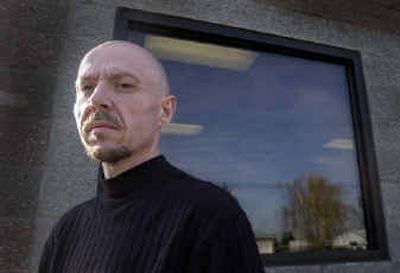
J.T. TAYLOR WILL HAVE TO HURDLE MULTIPLE SCLEROSIS to compete in Ironman Coeur d’Alene next year. He’s confident he can. He’s proved he can do just about anything he sets his heart on. Two years ago, J.T., who oversees Kootenai County’s Juvenile Detention Center, weighed 312 pounds. Now, he’s a lean 147 pounds. Willpower was the primary force behind the weight loss.
He was diagnosed with an aggressive form of multiple sclerosis in 1998. Heavy exercise was out. Last May, J.T. finished his first marathon. He has at least two more on his schedule. His MS symptoms have disappeared.
“I have no doubt he’ll do Ironman,” says Dannette Taylor, J.T.’s wife. “Once he has his mind set, that’s it.”
J.T., Dannette and their 11-year-old daughter, Jessica, volunteered at Ironman in June. He’d watched the Ironman triathlon in 2003 in Coeur d’Alene and was awestruck at the finish. He was 300 pounds then and just starting to lose weight.
“There were people I couldn’t believe could finish who were finishing,” he says. “That told me they had something in them to drive them.”
He knew he had the same drive. The multiple sclerosis diagnosis had smothered it for five years, but Jessica freed it just weeks before Ironman. She told him she’d try harder at her competitive swimming if he’d work on his health.
“The MS diagnosis was killing him,” Dannette says. “It was a hopeless situation, but when our daughter asked for help, he knew it was time to take his life back.”
J.T. insisted on switching his medication first. His old meds sickened him, changed his personality and left him depressed. His new medication, Copaxone from Teva Neuroscience Inc., eased his symptoms with no depressing side effects.
He decided to lose weight by sticking to no more than 1,000 calories a day. A chart of his daily progress shows a steady downward line for months. Watching Ironman in June last year strengthened his growing drive and motivated him to start running once his body could manage his weight.
That day arrived last year in August. J.T. began with an exhausting quarter-mile a day and slowly built to 50 miles a week. His MS symptoms abated. Doctors warned him to avoid fatigue and overheating himself. J.T. worked out in the 3 a.m. cool. His body continued to shrink and his symptoms didn’t return. J.T. set his sights on the Coeur d’Alene Marathon.
By marathon day in May he’d lost 150 pounds. He was lean and healthy. He finished strong and believes he could have run faster. Two weeks later, he ran in the Post Falls Duathlon even though he knew he should rest. He worried he’d lose steam without a goal.
Ironman followed the duathlon, carrying J.T.’s endorphin excitement along like a relay baton. He volunteered with Dannette and Jessica to run provision bags to moving cyclists. Visions of competing danced in his head. Only the entry fee gave him pause.
To prove to himself he could participate in Ironman, he ran 20 miles, then cycled 50. A check-up right before the marathon showed him in good health. He followed his doctor’s advice to constantly drink water. In August, he dove into the pool. It was a shock.
“It was like a brick hitting me,” J.T. says. “I couldn’t do anything. My daughter was laughing at me. It was extremely humbling.”
Dannette offered to help. She’d trained as a swim coach in case her daughter needed her help. Dannette watched J.T. swim and saw that his kick sometimes pulled him backward. Relearning to kick correctly was hard work, but J.T. was too determined for discouragement.
“The first time I ran a quarter mile, I puked,” he says, grinning. “But I kept at it.”
The cost was the discouraging part. Shoes, shorts, a wetsuit, a decent bike, swim goggles and a suit, bike helmet and padded shorts – expenses added up quickly. Then there was the $425 entry fee. J.T. followed cyclist Lance Armstrong’s example. Armstrong is a spokesman for Bristol-Myers Squibb, the company that manufactures medications that helped him beat cancer. J.T. contacted Teva Neuroscience, told them what Copaxone had enabled him to do despite his MS and asked for sponsorship.
Teva offered to pay for all equipment except a bike. Detention Center Chaplain Jeff Cheeseborough found an anonymous donor to cover J.T.’s Ironman entry fee. Then, Jeff called a friend who runs a bike shop in Santa Maria, Calif. His friend offered to build J.T. a racing bike for about $1,500. Jeff is raising donations now.
“People hear about what J.T. is doing and they want to help,” Jeff says. “He’s an inspiration.”
J.T. occasionally reminds himself how far he’s come by looking at his identification cards from the past three years. His face changes from round and fleshy to lean and sculpted over prominent cheek bones.
“Three years ago, I didn’t even know who I was,” he says. “Now, a piece of me is afraid to stop.”
He’s not likely to stop, not even after he sails across the Ironman finish line.