
Connecting with Mayans
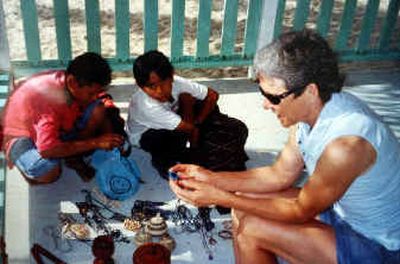
THE PACKAGE HAS GROWN on my dining room table for weeks. It began with photos – Victor Mas, 12, and William Sanchez, 11, showing me their crafts, Victor leaning against the door of his wood hut in southern Belize.
My husband, Tom, and I had promised to mail the boys copies of the pictures we took. But snapshots didn’t seem enough once we returned to Coeur d’Alene. Those boys had taken us out of our cozy existence and introduced us to a world we’d seen only on the Discovery Channel. They’d thrilled our senses and helped us understand that our definition of good living wasn’t everyone’s.
I want to show them where and how we live, help them connect with a different part of their world the way they helped us connect with the modern Mayans. But no picture books, calendars, children’s coloring books on Coeur d’Alene exist.
“If someone created such a thing, we’d sell so many,” a clerk at Borders Books and Music told me after I rejected her idea to mail Victor and William a booklet featuring the EXCEL Foundation’s moose sculptures throughout Coeur d’Alene. “We get asked all the time.”
We met the boys in July in Placentia, a small town at the end of a peninsula that juts into the Caribbean. They were among the reserved Mayan vendors selling hand-woven baskets, sandstone carvings, jewelry, boxes, masks and bowls to ocean-loving visitors from the Netherlands, Norway, Brazil, Germany and dozens of other countries.
Victor and William were more interested in talking and learning about people and their home countries than sales. We talked for half an hour before they remembered to pull out the crafts in their Spiderman backpacks.
Their craft sales pay for school. Victor’s dad, Sebastian, also takes visitors that his son brings home on tours to a jaguar preserve to raise money. We bought a sandstone carving Victor said he’d made and a box William made, and marveled at their skills. Victor pressed us to visit his home, see crafts in the making, meet his parents, tour the ruins of a Mayan village, possibly take his dad’s tour and spend the night.
I trust everyone, so I turned to Tom, my link to common sense. He agreed we’d go home with Victor the next day for a few hours. We pondered the risk that night, but instinct told us to go.
The boys rose at 4 the next morning to catch a bus, then boat, meet us at 6:30 in Placentia and return home. We buzzed on a motorboat around mangrove islands to the mainland, then waited three hours for a bus heading south. It was worth the wait. Victor stopped the bus after an hour on a dirt highway with one hut in the trees 50 yards from the road – his home.
We stared at the thatched roof that topped the weathered wood slats, then entered a doorway with no door. It was a single room the size of our living room and it was dark, lighted only by the sun through two doorways that doubled as windows. Hammocks slung over the rafters and a low table with two footstools as seats were the only furniture. The floor was rough concrete. A rock hearth was the stove.
Sebastian warmly invited us to sit on the rope hammocks. We sat, awestruck, until Victor led us out the back door, past chickens in the damp red dirt toward an area where his family makes crafts. Victor’s adult sister walked by, comfortably topless, from their bathing area and nodded her greeting.
Half-finished sandstone carvings waited on a table for more work. Victor talked about harvesting the sandstone, then led us with William a half mile up a steep and rocky dirt road lined with palms and giant ceiba trees to Nim Li Punit, a 1,000-year-old Mayan village in ruins. The boys treated the ruins with casual respect. They know them thoroughly, appreciate their historical significance and anticipate what visitors want to know without pummeling their guests with information.
I assumed the Mayans were ancestors to Victor and William, but the boys were skeptical. The Mayans had been dead a long time, Victor told me. He and William are Kek’chi, which, I learned later, is a modern branch of the ancient Mayans.
Back in Victor’s house, his mother and sister sat on footstools and patted out fresh tortillas while Victor shared his schoolbooks with us. His sister’s husband, Marcos Canti, showed us masks he’s learning to carve from rosewood. Tom asked to buy a mask, which surprised Marcos and inspired Victor to show us his family’s prize possession, a Mayan stone cutting tool Sebastian had found in their field. We held the tool in Victor’s home and centuries temporarily disappeared. His mother reinforced the moment by tossing her tortillas on the hearth and inviting us to eat.
We dined on hot tortillas filled with spicy beans and drank cool, sweet coffee from a variety of dishes the family had salvaged. Victor’s nephew, a toddler, was the entertainment as, I suspect, he often is. Life was simple in Victor’s home and invitingly peaceful. It was hard to climb on the bus to Placentia when it arrived. Victor stiffened when I impulsively hugged him. I was too overwhelmed to stop myself.
With the Belize pictures we send Victor and William, I’ll include new snapshots of their crafts in our home. I want them to see Coeur d’Alene, the lake, the beauty thousands of miles north of them. I want to give them what they gave us, but photos are the best I can offer. And friendship. Of course, that’s really for us.