
Flower power

WHAT IS IT ABOUT the sunflower – the bloom that Vincent van Gogh immortalized, that Kansas bestowed state honors on, that the avian crowd treats as a neon welcome mat – that brings an instant smile to children’s faces?
“It’s the most human-looking of all plants,” says Larry Kleingartner, executive director of the National Sunflower Association. “They look like they are alive. Most grow to human height, and when they are in bloom their leaves look like arms, and you have this smiling, cheerful face looking at you.”
But therein lies the rub: The smiling, cheerful face doesn’t always look at you. Although a growing sunflower will follow the sun from morning till nightfall, a mature plant will face east to protect its seeds from the hottest rays of the sun. Hence, many gardeners are treated to the backside of their labors. Perhaps sunflowers are more like human than we care to admit?
Anthropomorphism aside, perhaps no plants are better for a children’s garden than gentle, giant sunflowers. They are easy to grow and rapidly become exclamation points in a home’s landscape.
“I think children are drawn to them for three reasons,” says Yvonne Savio, manager of the University of California Cooperative Extension’s Common Ground Garden Program, which promotes gardening among all ages. “First, the scale – they are just these big monsters towering over them – then the bright yellow color and the idea that it makes seeds that we can actually eat.”
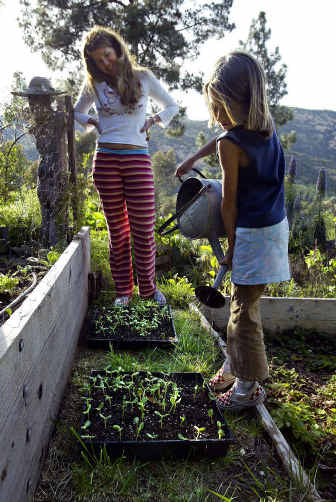
For Los Angeles gardener Shannon McGiffert and daughter Natalie, 8, sunflowers are a springtime tradition. About a week before Natalie’s birthday in March, the two carefully line flats with newspapers and potting soil and sprinkle in a generous amount of seeds.
“We take a ‘the-more-the-merrier’ attitude,” McGiffert says, “allowing for the half that don’t actually work out.” They bring the flats inside at night to foil the vermin that see a buffet.
“Sunflowers really look like the sun, and I like that,” Natalie says.
Woodworth recommends more precise planting guidelines for gardeners not in a rush to see blooms. She advises mixing soil with several inches of compost in a garden plot and planting the seeds about half an inch deep in rows about a foot apart.
“The kids use their math skills, dividing the size of the plot to see how many seeds can be planted,” she says.
They also must understand the flower’s aforementioned tendency to face east, and then, of course, there are the history lessons: Native Americans used parts of the sunflower plant to treat rattlesnake bites, and made bread from sunflower meal. Spanish explorers are said to have brought back sunflower seeds from the New World in the 1500s. How about some science? Sunflowers planted on plastic foam rafts in contaminated ponds near the 1986 Chernobyl nuclear power plant accident absorbed some of the ponds’ radioactivity, making the flowers an unsung hero of the cleanup effort.
“Helianthus annuus,” the common sunflower, must be planted in full sun and the seedling kept well-watered. But don’t allow it to shade other sun worshippers in the garden.
Giant sunflowers are the most fun to grow, but they require more work. The “Mammoth Russian” giants with their Frisbee-size flowers and sapling-like stalks, or the “Kong” sunflowers that reach 10 to 15 feet in height, need stake support and do best near a fence or a garage that can anchor them.
Sunflowers pop out of the ground in seven to 10 days, satisfying the instant gratification needs of children. At this early stage, the seedlings need protection from birds and other animals. A little tent of chicken wire or a milk jug with the ends cut off keep predators away.
Within 80 days, the flowers usually are showing their impressive size. For the seriously impatient, a few varieties bloom in 50 days. The “Sundance Kid Dwarf” is one of the fastest to mature and grows well in containers.