
Branching out
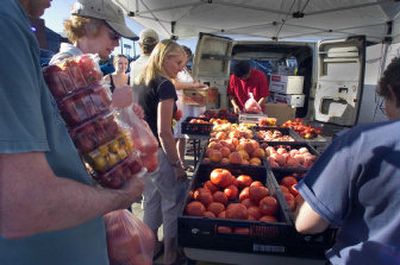
John Progar and Michelle Michney drive 50 miles early each Saturday morning during the summer, from their one-acre Newport, Wash., farm to their stall at the Liberty Lake Farmers’ Market.
They pack up pounds of just-picked vegetables, with the hope of carrying a much lighter load home. Sometimes they do; other times, they aren’t so lucky.
“There’s a funny misconception that farmers are going home and counting their money at the end of the day,” Progar said. “Some people are, but most of us are doing it because we like teaching people about organic food.”
Progar and Michney moved to Newport from Ann Arbor, Mich., in March, just in time to start planting their crops. They’re among a growing number of area farmers supplying small community markets in Spokane and North Idaho. And they’re just the type of small-scale farmer Holli Parker, manager of the Liberty Lake and Moran Prairie farmers’ markets, has been working hard to attract.
Parker, who has used newspaper advertising and word of mouth to spread the word about her farmers’ markets to both farmers and customers, said the markets are becoming increasingly popular in the Inland Northwest, following a national trend.
“People love being able to get fresh produce for the week and knowing they can talk with the farmer,” she said. “You know there’s a good product, (and) if there’s a problem, you can go back.”
Parker manages the two markets – Liberty Lake started four years ago, Moran Prairie is in its second year – for Spokane Neighborhood Markets, a nonprofit run under the umbrella of the Greenstone Foundation, operated by developer Jim Frank. Frank said he started the foundation to spur the development of neighborhood-based farmers’ markets. He supports the markets now, but his goal is for them to eventually become self-supporting.”We want to contribute to the social fabric of the communities and the neighborhoods,” he said. “You don’t have to hop in your own car and go.”Besides enhancing the communities, Frank said he also wants to help farmers. In accordance with Washington state regulations, farmer-supplied produce must account for at least half of the sales at the markets; wholesaling is not allowed; and crafts are limited.
“A lot of farmers went out of business because there was no outlet for them,” Frank said.
Paul and Susan Puhek, who own and operate the Double P Ranch Produce in Otis Orchards, say they’re happy to have a more convenient place to sell their produce.
Paul Puhek said the Liberty Lake market is minutes from his home, making it easy to transport produce from his half-acre farm and dozens of eggs from his 40 chickens. He said he was discouraged by the Spokane Farmers’ Market because he didn’t want to compete with the large-scale farms that sell there. Now, after four years at Liberty Lake, he has grown and modified his small farm to meet the needs of the expanding market.
“We try to ask our customers what they want,” he said. “It’s really one of those things where the market comes first, and the farmers will come later.”
Barbara Arnold, vice president of the Kootenai County Farmers’ Market in Coeur d’Alene, said face-to-face interaction is a vital part of the market’s business, with customers asking about everything from recipes to mystery garden herbs.
“It’s a connection to the farmer to the customer to the crafter,” she said.
Now in its 20th season and fourth location, the Kootenai County market has 74 crafts and food vendors – 45 are season-pass holders, the remainder are picked on a lottery system – and more than 2,500 visitors on Saturdays. Arnold said the customer base at the market has grown about 50 percent in the past five years, due in part to the area’s booming population.
Advertising is done primarily through word of mouth and events such as the “Feast with the Farmers,” an annual evening where selected customers are treated to a meal cooked primarily with ingredients from the market.
Jennifer Hall, small-farm marketing coordinator for Washington State University’s extension program in Spokane, recently spearheaded a similar program at the Spokane Farmers’ Market called “Shop with the Chef.”
Hall said farmers’ markets are thriving because of a growing interest in healthier eating.
It’s difficult to track the exact number of farmers’ markets in the area because many are informal and sporadic. But according to the Washington and Idaho state farmers’ market associations, there are at least 14 officially organized farmers’ markets in Eastern Washington and North Idaho; a handful started in the Spokane area in the past five years.
“There’s a lot more opportunity than there has been, and a growing demand,” Hall said.
Her biggest problem is choosing from among the potential vendors to get the right variety for the Spokane market, a food-only venue established in the late ‘90s.
Spokane Farmers’ Market President Jeff Herman said the market, on Second Avenue between Division and Browne Streets, is looking to relocate to the University District, among other possible areas, to give it room to expand.
“The way we see it is that this market would improve the sense of community in Spokane,” he said of the potential expansion. “It would make it a more livable city and greatly improve the image of Spokane.”On a recent Saturday, the market had about 1,700 customers, but Herman would like to see that number grow nearly three-fold in several years. He said he wants to add play areas for children, a restroom and more parking. Still, he said the market has grown “phenomenally,” drawing 30 percent to 50 percent more customers each year.
“There’s no reason Spokane can’t do $1 million worth of business if it was set up right,” he said, adding that economic impact isn’t even the most important aspect of the market. “How it affects the community,” is the key, Herman said. “A lot of it is beyond what you actually see.”
David Bauermeister, director of agriculture and natural resources at the Spokane Regional Chamber of Commerce, said the economic impact of farmers’ markets is hard to track, but that a dollar spent at a market generally circulates in the community seven or eight times — several times more than if it were spent at a supermarket.
Rose Ayars, business development specialist for the Spokane Neighborhood Action Program, said farmers’ markets bring extra value to a community because they help foster minority businesses and entrepreneurs.
“There’s more opportunity than ever for micro-enterprise to provide independent types of products and services,” she said. “The small farmer is a big piece of that.”
Plus, she said, “It creates a community where people of vast socio-economic and cultural diversity come to a public space to be together.”
Ayars said funding for things such as booth set-up and location rent is the biggest barrier to the expansion of farmers’ markets. Disputes over the percentage of crafts vendors versus food vendors and the sale of wholesale goods have also sparked frustration, she said.
Vickie Tenney, president of the Farmers’ Market at Sandpoint, said there are about 100 food and crafts vendors who rotate through the market there, with more than 30 on a waiting list. She said the market, which started with a handful of farmers 17 years ago, now has no room to expand.
“There has been large growth in the last three to four years,” she said. “We have seen an influx of people wanting fresh produce. People want to know where their produce comes from, and they want to know that it is organic or chemical free.”
For now, Newport farmers Progar and Michney hold down other jobs to offset the costs of farming. But as the organic food market grows, driven by more visible marketing and a ready supply, Progar said he hopes that will change.
“Our vision is to drive up our driveway and have people there waiting for us because they want our produce so bad,” he said. “Until then, we’ll keep driving to Liberty Lake.”