
Netanyahu challenges Sharon
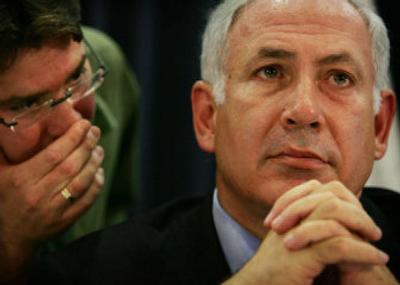
JERUSALEM – Benjamin Netanyahu announced Tuesday that he would try to unseat Prime Minister Ariel Sharon as leader of the conservative Likud Party, a move that could split Israel’s dominant political faction.
Netanyahu’s challenge was widely expected, coming three weeks after he resigned as finance minister to protest Sharon’s decision to pull Jewish settlers and soldiers from the Gaza Strip and four small sites in the northern West Bank.
The struggle over who will lead the Likud will mean several months of political turmoil that could end with Israel’s leading party cutting short its hold on power in a spasm of internal strife. Netanyahu and his allies are expected to seek a primary in November, meaning early national elections could come as soon as February.
Elections are formally scheduled for November 2006, although an early vote has seemed likely for months.
Netanyahu, 55, took aim at the Gaza pullout, which he said left Israel more vulnerable to armed attack by Palestinian fighters without bringing benefits in return. Sharon’s government completed the pullout of Gaza settlers last week; it plans in the coming weeks to withdraw the Israeli military from the territory.
In an appeal to the Likud’s right wing, Netanyahu said that Sharon, a hawkish former general who for decades was the chief sponsor of Israel’s settlement-building effort, was following a leftist path. Netanyahu said there would be no unilateral withdrawals under his leadership.
“The man who received our votes to lead the movement in the Likud’s spirit turned his back on us,” Netanyahu said during a nationally broadcast news conference in Tel Aviv.
Netanyahu’s challenge places Sharon, 77, in a difficult spot. The prime minister faces widespread anger within the Likud over his decision to proceed with the Gaza pullout despite losing a party referendum on the issue in May 2004. Uzi Landau, a member of parliament who vigorously opposed the withdrawal, also plans to run for Likud leader.
Sharon’s soft support leaves him to weigh whether to bolt from Likud, perhaps taking a splinter faction with him into general elections.
Despite opposition inside Likud, Sharon remains the favored candidate among the general public, and the relative smoothness with which the Gaza withdrawal took place appears to have added to that support.
Polls show Sharon winning a national race over possible rivals from Likud and the left-leaning Labor Party, and winning more parliament seats as head of a Likud ticket than Netanyahu would. Likud is the biggest parliamentary faction, with 40 seats in the 120-member body.
Some analysts have talked of a “big bang” – a possible realignment of Israeli politics in which Sharon would head a new centrist party, with a fragment of Likud merging with Labor and the secular Shinui Party.
Political commentator Hanan Kristal told Israel Radio that a split in Likud was almost inevitable.
Already some leading party members are trying to prevent such a rift. A decisive moment will come Sept. 26, when the Likud’s 3,000-member central committee is scheduled to set a date for a primary.