
Hawaii’s ports are bustling, thanks to a new fleet of ships and a lot of vacation-seeking baby boomers
HONOLULU – Hawaii’s cruise ship industry floundered in the days following the Sept. 11, 2001, terrorist attacks.
The state’s sole interisland cruise operator was flooded with cancellations while bookings plummeted by 50 percent. American Classic Voyages Inc. filed for bankruptcy protection just 38 days after the attack and shut down its Hawaii operations, scuttling plans for two new ships.
Since then, however, the Hawaii cruise ship industry has made an aggressive recovery. It has seen unprecedented growth, led by Norwegian Cruise Line and fueled by vacation-starved baby boomers.
What used to be a seasonal business with a few ships making calls here is now a year-round mainstay, with Hawaii’s ports bustling with activity.
“For us, it’s a huge market,” says Robert Kritzman, NCL’s executive vice president and managing director of Hawaii operations.
“Very few people have cruised Hawaii. There’s an untapped market still there and Hawaii is a phenomenal place to come through.”
Norwegian, which operates the U.S. subsidiary NCL America, is betting big on Hawaii, spending $1.4 billion on three luxury liners to serve the islands. The Miami-based company estimates it will own about 85 percent of the cruise ship market here by 2007.
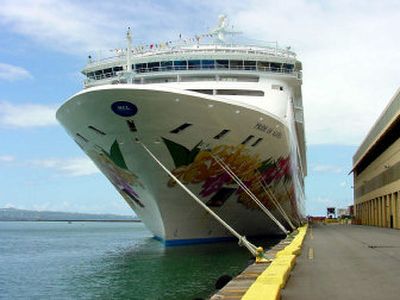
The 1,900-passenger Pride of Aloha was the first, introduced in 2004. Formerly the Norwegian Sky, it was redesigned with a Hawaii theme and reflagged to a U.S. vessel, allowing it to carry passengers solely between U.S. ports.
The brand new 2,100-passenger Pride of America made its debut in June 2005 as the largest U.S.-flagged cruise ship ever.
By the time its sister ship, the Pride of Hawaii, is built and arrives in the summer of 2006, the company will have three year-round lavish cruise ships – as well as a seasonal foreign-flagged vessel – carrying an estimated 8,000 passengers per week.
“Being able to welcome an additional 8,000 people on a weekly basis will allow us to continue to grow our economy because we are almost at our capacity where our land-based accommodations are concerned,” says Marsha Weinert, the state’s tourism liaison.
In July 2005, Hawaii hosted 22,725 cruise ship passengers, up 57 percent from July 2004, according to the latest state figures.
Hawaii had 151,164 cruise passengers this year through July 2005, up 34.6 percent from the first seven months of 2004. About two-thirds of the visitors are extending their vacations and staying a couple of days in hotels or time-share units.
John Hansen, president of the North West Cruiseship Association, projects the number of cruise ship passengers in Hawaii will exceed 400,000 in 2006, up from about a peak of 150,000 annually before the 2001 terrorist attacks.
“We think it’s a great way to see Hawaii, especially for the first-time visitor,” NCL’s Kritzman says. “They get to see all four major islands while packing and unpacking once.”
The ships also provide a unique vantage point of the islands, sailing sail past the glowing lava fields of Kilauea volcano on the Big Island, the remote green peaks of the Na Pali coast on Kauai’s North Shore and the urban cityscape of Oahu.
But not everyone has been a fan of the cruise ships.
Environmentalists say the ships harm Hawaii’s sensitive ecosystem, including its pristine coral reefs, and threaten the rural charm of the islands. They have long complained about a lack of oversight and laws regulating the cruise ship industry in Hawaii.
“This is not Florida. This is a fragile island that is creaking under the weight of people,” says Cha Smith, executive director of KAHEA, an advocate for environmental and native Hawaiian causes.
KAHEA is working on launching a program called “Na Maka O Ke Kai,” or the “Eyes of the Ocean,” encouraging people to report fouled water or debris left behind by cruise ships, which they call “giant floating cities.”
Kritzman said his state-of-the-art ships go far beyond what is required by law. The ships are self-sufficient, each generating its own electricity and drinking water. The vessels also treat sewage through a high-tech filtration process with the sludge heated and dried to be offloaded or burned in the ship’s incinerator.
“I think this is a very low-impact form of tourism,” he says. “We think this does not have the same impact as building a resort.”