
A mixed-up heart

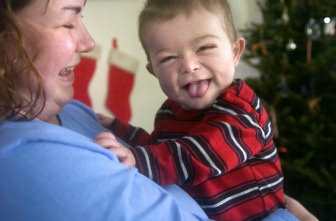
In those precious first days after a baby’s birth, mothers learn many things about their newborns.
Whether they like to be swaddled. What tune lulls them to sleep. How they prefer to be held.
But in the days after Jacob Hoffman’s birth in June 2004 at Sacred Heart Medical Center, his mom, Brandi, kept learning things she didn’t want to know.
An early ultrasound already had warned her there were problems with little Jacob’s heart. But the troubles kept mounting in his first days on Earth.
Ultimately, he would become the youngest patient in the Inland Northwest to undergo a risky but lifesaving procedure.
Jacob’s heart had developed on the wrong side of his body. Not only that, he had holes in his heart. And much of his heart’s anatomy, the structures that make it effectively pump blood through his body, were not lined up as they should have been.
Plus, he was born without a spleen, leaving him susceptible to infection.
“That first month was, ‘We found this and we found this,’ ” Hoffman says. “Is it ever going to end?”
Jacob had a congenital heart condition known as Tetralogy of Fallot, a four-pronged disorder that causes, among other things, oxygen-poor blood to be pumped into the body. That condition was compounded by the fact that he suffers from heterotaxy syndrome, which means that structures that are supposed to develop on one side of the body do not develop properly or at all (which explains his lack of a spleen and the fact that his stomach is on the wrong side).
Heterotaxy is an umbrella term for a condition that varies in severity from person to person, but it basically left Jacob with a “mixed-up heart,” says Dr. Richard Jensen, a pediatric cardiologist who diagnosed the disorder while the baby was still in the womb.
Surgeons would spend much of Jacob’s first year of life repairing his scrambled heart.
At 4 days old, when his heart was just the size of his tiny fist, Jacob underwent his first surgery, a palliative procedure to improve blood flow.
He had a food tube inserted into his stomach before the end of his first month, a device that’s still in place today.
At 5½ months, he had a second heart surgery, this one designed to repair veins feeding his lungs.
And at 10 months, he underwent a massive operation to fix many of the remaining problems in his heart
Between the surgeries, complications and respiratory infections, Jacob spent just four of his first 12 months at home, his mom says.
“He was just in failing mode,” she says.
That third heart surgery was supposed to have been his final major procedure.
And then, last July, his heart started beating dangerously fast, nearly 300 beats per minute (a normal resting pulse for a child his age is 70 to 120 beats per minute).
Drugs to slow down the rhythm did not work.
“After that final repair, to have something that huge pop up, it was really scary,” says Brandi, 26. “It was very disconcerting.”
Jacob could not live long with that condition. Doctors weighed the risks and decided to treat him with radiofrequency ablation, a procedure commonly used to treat rapid heartbeat in adults that works by burning away the part of the heart causing the bad rhythm.
It was the first time doctors here tried the procedure not only on a patient so young, but on one with such irregular features in his heart, says Dr. Chris Anderson, the pediatric electrophysiologist who performed the ablation.
Imagine taking a Spokane roadmap, ripping it to shreds, tossing the pieces in the air and taping it back together. Then try to figure out where you’re going.
That’s what Anderson had to contend with in Jacob’s heart.
“Instead of working with normal heart anatomy where you know where all the landmarks are, you’re basically starting from scratch,” Anderson says. “Basically the arrhythmia could’ve been coming from anywhere.”
And, to make it even more challenging, he had to solve the problem on an 18-pound baby.
First, Anderson threaded the smallest catheters he could find into veins as thin as spaghetti noodles. In adults, it takes about 10 or 15 minutes to insert the catheters, Anderson says. In Jacob’s case, it took about an hour and a half.
With the catheters in place, Anderson could gingerly move them around the heart’s upper chambers to find the source of the arrhythmia.
Once he found the spot, he used a special catheter that emits heat to burn away the problem.
“The whole procedure was pretty dicey, to be honest,” he says. “We’re worried about damaging blood vessels. We’re worried about perforating the heart, … We’re worried about finding exactly where the spot is so we don’t damage too much heart muscle.”
But none of those worries came true, and Jacob, now 18 months old, is starting to get to live the normal life of a toddler.
Being hospitalized for so long has delayed his development a bit. He’s not walking yet, but he can roll all over and recently started standing with help.
He says a handful of words, but, says Brandi, “He still can’t say ‘Mom.’ ” Just then, Jacob looks up with a mischievous grin and says, “Dad.”
Jacob, who has enormous brown eyes and an infectious smile, likes to watch “Dora the Explorer,” play patty-cake, and pull the hair of his 3-year-old sister, Isabell.”He’s a snuggle bug,” says his mom.
He still struggles with some lung problems that doctors are hopeful he will outgrow. But otherwise, it seems as if the roughest patch is behind him.
“We’re very blessed,” Brandi says, holding back tears.