
Flash wasn’t in Sandberg’s makeup

Bill Harper had just signed a 20th-round draft choice for $25,000 – or about $20,000 more than the going rate in 1978. Now he had to break the news to his boss.
At 3 in the morning.
In Spokane, it was only midnight. Harper – the Northwest scout for the Philadelphia Phillies – and crosschecker Moose Johnson had just left the living room of Ryne Sandberg on West Augusta with a signed contract, something only hours before they’d had no particular hope of procuring since their prey had earlier signed a football letter to play at Washington State.
“Moose, we’ve got to call Dallas,” Harper said, referencing Dallas Green, then Philadelphia’s scouting director.
“You call him,” said Johnson, referencing Green’s explosive temper.
When he picked up the phone in Philadelphia, Green was predictably prickly, until he dragged the details out of Harper as to how much he’d spent. Then Green was merely silent.
“I’m thinking, ‘There goes my job, and maybe Moose’s, too,’ ” Harper recalled. “Then finally he says, ‘You know what, Bill? He’d better be able to play.’ “
So what do you think – did he pass the audition?
The election of Ryne Dee Sandberg to the Baseball Hall of Fame on Tuesday wasn’t necessary to validate Bill Harper’s eye for talent or his fiscal judgment or even Sandberg’s sensational baseball career with the Chicago Cubs, though it does all those things in the eyes of a public which thirsts for someone else’s official stamp of approval before conferring its own.
Now he has it all.
“It was,” Sandberg admitted Tuesday, “one of the more incredible phone calls I’ve ever received.”
Well, the truly incredible part is that it didn’t come two years ago when Sandberg was first eligible for the hall. But needing three tries cannot cheapen the prize, nor can the narrow margin of approval – just six votes out of 516 cast.
Safe at home is safe at home, whether it’s by a millimeter or a mile.
Sandberg didn’t fidget through those first two ballots, when he garnered 49 and 61 percent of the vote, nor did he apologize for sneaking over the 75-percent bar on his third time at bat.
“I learned a long time ago there are no guarantees in the game of baseball,” he said. “That’s the way I’ve looked at it. There have been tremendous, tremendous players who waited longer than I’ve had to wait to get into the Hall of Fame. I don’t think it’s ever too late and I don’t think it diminishes the honor at all.
“You’re either in the Hall of Fame or you’re not.”
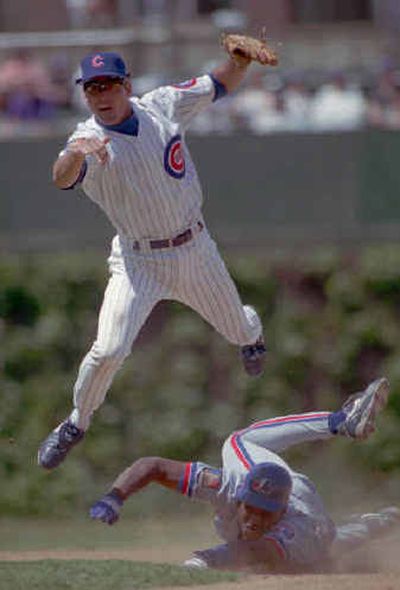
He’s in for any number of reasons, the obvious one being that he was the most consistent and most complete second baseman of his era – a 15-year stretch during which he was 10 times an All-Star, nine times a Gold Glover, once a home-run champion and once Most Valuable Player of the National League.
If he redefined the prototype for the position – by paving the way for the Jeff Kents, Alfonso Sorianos, Bret Boones and other power-hitting second basemen – he also retrofitted it with a stoic and unswerving approach out of some other era.
He was all about the game and not about himself.
Even with 40-home-run pop in his bat, neither his game nor his personality was loud, showy or even the slightest bit charismatic. But he was ruthlessly consistent – in the field, where he got to balls and made the plays, and at bat, where he drove the ball and ran it out.
Along with Sandberg’s physical tools – his speed and his power to the alleys – that steadiness is what Harper saw in him as a high school player at North Central, what he rued losing when the Phillies traded Sandberg to Chicago in 1982 and even what may have worked against him in the minds of voters who tend to appreciate more outsized characters with flash.
Of course, Hall of Fame voting is not a beauty contest but a pecking party, in which any purported deficiency or mitigating factor is exposed and endlessly debated. Sandberg found his offensive performance docked by critics for having played all those years in the friendly confines of Wrigley Field, and his stellar defensive play shortchanged by a silly notion that he didn’t dirty his uniform enough diving for ground balls.
Seriously?
Somehow, while being so stubbornly vertical, Sandberg led the National League in assists at his position in six of his Gold Glove seasons, and in total chances three times – products of range and effort.
“I got to balls behind second base and I got to balls behind the first baseman,” he maintained. “I used my range to make plays. To dive for no reason – when you can’t get an out or prevent a run at home – is to me not worth anything.”
Some of that rap tailed him even from high school. He made the game look easy, a knack often mistaken for indifference when it is something else altogether.
His career had its hiccups, of course – the family trials and frustration with the Cubs organization that drove him into an early retirement, which he aborted after a year and a half, and the team’s inability to win in the post-season during his tenure. Surely he could have more easily fitted himself for a World Series ring by demanding a trade or signing elsewhere, but like another future Hall of Famer from his hometown, John Stockton, he was as allegiant as he was consistent.
On Tuesday, he cited the support of family, faculty and friends and “the hard-working attitude that’s in Spokane” for helping fashion his ethic, and took time to acknowledge that remarkable circumstance of Stockton, Mark Rypien and him – three marquee pros – growing up four years and four miles apart.
“That’s pretty incredible for a small town like that,” he said. “They take their sports very seriously up there. It’s on the front page of the paper. I remember my sophomore year in high school starting at quarterback and after the first game I had a big picture on the front page.
“Just to see my parents’ faces and the feeling I got out of the importance of athletics and the way it was covered in that town was incredible.”
Even more incredible to Bill Harper is that Sandberg will go to Cooperstown in a Cubs cap and not as a Phillie. But that was Dallas Green’s doing, too. When he took the Cubs’ general manager job after the 1981 season, Green engineered a trade – his shortstop, Ivan DeJesus, to Philadelphia for Larry Bowa.
And a throw-in named Ryne Sandberg.
At his home in Corvallis, Ore., it was Harper’s turn to get a surprise phone call.
“I told you, Harper,” Green growled. “I told you I’d get Sandberg.”
Harper looked at the clock on his bed table. It was 2:30 in the morning.