
Welcome back
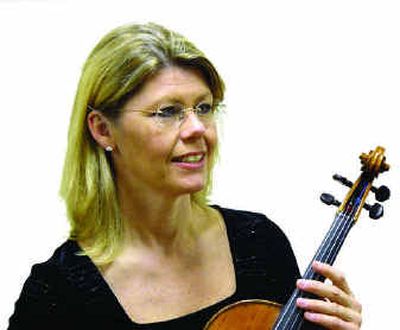
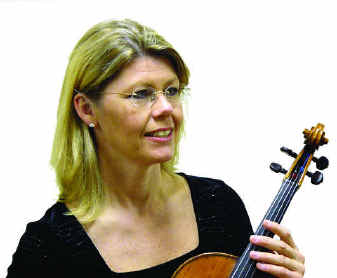
Violist Lois Landsverk will be coming back to her roots at the Spokane Symphony’s chamber orchestra concerts at The Met on Sunday and Tuesday.
Though Landsverk grew up in Spokane and began her musical career here, she has spent most of her professional life in Europe. She is the second of three musicians who are featured in the orchestra’s “Spokane Homecoming” series this season at The Met.
Landsverk will perform Karl Stamitz’s Concerto in D major for Viola and Orchestra on a program that includes Mozart’s Overture to “The Impresario,” Mendelssohn’s “Italian” Symphony and the Spokane premiere of Takshi Yoshimatsu’s “Threnody for Toki.”
Morihiko Nakahara, in his second season as the symphony’s associate conductor, will conduct.
Landsverk was born in India, where her parents, Obert and Helen Landsverk, were missionaries. They returned to the United States when she was 4; her father became pastor at Emmanuel Lutheran Church and her mother, a self-taught musician, assumed teaching duties at Deaconess Hospital.
After beginning her violin studies at age 7 with Sr. Cecilia Claire at Holy Names Academy, Landsverk continued her studies here with Helen de la Fuente.
Landsverk was studying violin at the University of Cincinnati’s College Conservatory when she was lured away to the viola by the playing of the conservatory’s new viola teacher, Donald McInnes, one of the great virtuosos of the instrument.
She continued her studies in Austria at the Mozarteum in Salzburg and began playing viola in orchestras including the Mozarteum Orchestra, Cologne Radio Orchestra, the Berlin Radio Symphony and the Bamburg Symphony, where she is principal violist.
Landsverk last performed in Spokane in 1989 with the Spokane String Quartet.
As for her featured piece at The Met, Nakahara says, “There are not so many viola concertos. Stamitz is one of the first to really write one that violists still enjoy playing.”
Stamitz’s life overlapped that of Mozart; he was born 10 years earlier, and lived another 10 after Mozart died. Like most composers of that time, he was enormously prolific, writing more than 80 symphonies, dozens of concertos for various solo instruments and many other works.
In addition to the Mozart and Stamitz works and Mendelssohn’s famous “Italian” Symphony, which will close the concerts, Nakahara has programmed “Threnody for Toki” by contemporary Japanese composer Yoshimatsu.
“The reason this piece is on this concert goes back to a conversation I had with (former music director) Fabio Mechetti before he left Spokane last year,” Nakahara says. “Knowing that Fabio had conducted several times in Japan, I asked him if there were any Japanese pieces or composers he especially liked, and this is one of those he mentioned.
“I had heard it myself and really liked it, too,” he says. “It is one of the most often-played symphonic works in Japan. I haven’t come across many pieces that contain the amount of dissonance and apparent chaos this does but still sound so beautiful.”
Yoshimatsu grew up playing guitar and drums in rock bands, and when his interest turned to classical music he decided not to take composition lesson.
“He considered himself a maverick,” Nakahara says, “didn’t like the direction Japanese symphonic music was taking – too avant-garde, too academic, more enlightenment and not enough entertainment.”
“Threnody for Toki” is Yoshimatsu’s lament for the toki, the Japanese crested ibis which has been near extinction since the beginning of the 20th century.
“Many of Yoshimatsu’s pieces are inspired by birds or other flying things,” Nakahara says. “His guitar concerto is called Pegasus and there are pieces about angels, too.
” ‘Threnody’ is for strings divided to the right and left of the conductor with piano in the middle. Especially if you sit in the balcony, you can see how the open piano looks like the wings of a bird,” he says.
“Yoshimatsu is, I think, comparing the near-extinction of the toki to the near-extinction of beauty in the arts and hoping to preserve some that beauty in his music.”
As is customary with the symphony’s Met performances, Nakahara will present verbal program notes preceding each work on the program.