
ABCs of the ATVs
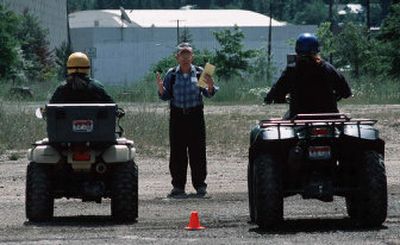
Differentiating the students from the instructors was impossible at Idaho’s first Responsible Rider ATV course late last month.
“We’re all students today,” said Ron Hood of the Wallace-based High Mountain ATV Association.
Indeed, the Idaho Parks and Recreation Department had honored Wallace as the site for the first Responsible Rider course for instructors. After a day of learning the curriculum, the 10 instructors-in-training had to practice their new teaching skills to five students ranging from 8 years old to adult.
“These two clubs have taken a real active interest in rider training,” said Rich Gummersall, off-road-vehicle program manager for the Idaho Parks and Recreation Department.
“We wanted to be able to offer the state’s new safety course as part of our annual Jamboree,” said Hood, referring to the 11th annual ATV Jamboree and ATV Rodeo, a week-long event that starts Monday in Wallace.
The training instructors from North Idaho clubs and a sheriff’s deputy experimented with delivery as they each introduced a segment of the 41/2-hour course that soon will be offered statewide.
Bill Barnes of Backcountry ATV Association in Coeur d’Alene invoked some humor in his presentation on using hand signals.
“I’d like to emphasize the ‘stop’ signal,” he said to the five students sitting on their ATVs in the parking lot across from the Wallace Visitor Center. “We’re old and you don’t want to hit us. We make really big bumps.”
“Seriously,” he said later, “learning signals is really important because when you’re in a group of machines you can’t hear a thing.
“We had to laugh yesterday when it was just the instructors training. We collectively have about 100 years of ATV experience, and we were all over the place on this course. It wasn’t pretty.”
Wallace ATV veteran Earl Castleberry, 70, has more than his share of all that experience, and he was eager to share it all with new students.
Castleberry, the trail coordinator for the many group rides that will be offered during the Jamboree _ including a 100-miler to Montana’s 10,000 Silver Dollars Bar and back — said you’re never too old to learn new riding techniques.
The Responsible Riders course covers rules and signals, equipment inspections, operating ATVs, a variety of turning maneuvers and figure eights while riding with multiple machines, stops, obstacles, responsible riding techniques, traversing hills and trail riding.
“All of the instructors are learning something about riding ATVs from this,” said Jack Rupp of Osburn. “I’ve learned that I’ve developed bad habits in my years of riding. Learning this course material and then teaching it forces you to become a more responsible rider.”
Bruce Manhart of Wallace was pleased to have his 11-year-old daughter, Carly, taking the course as a guinea pig student for the fledgling instructors. The course requires parents to accompany their kids.
“We moved up from California a year ago, and I bought the whole family ATVs because it’s the Mecca for that up here,” he said. “We can ride from the house.
“It’s real important for riders to learn good habits from the start. Personally, I had ridden some before, but when I took a course I learned a lot of things on how to maneuver.”
Making more safety classes available for ATV riders is good for all sorts of reasons, including domestic tranquility, he said.
“It’s healthier to have somebody else teach your wife,” he said.
Off-road vehicle groups already offer a few training options, including the Tread Lightly program, which focuses on environmental concerns.
Idaho’s new Responsible Rider course was honed from existing courses during eight months of collaboration with industry and rider groups, said Gummersall, who’s based in Boise.
“We married our course very close to Utah’s since we have so many users who cross the borders,” he said. “We’re looking at having all the Western states come together with one educational program so that if it ever becomes required, everybody’s certification will be honored by each state.”
Gummersall expects a movement toward requiring riders under 16 years old to complete an ATV training course, noting that it would likely be similar to the current training required for new hunters.
Organized ATV groups tend to support the idea.
“We need to educate riders otherwise we’re going to lose more places to ride,” Hood said, referring to off-roading damage that has led to access restrictions on timber company lands as well as public lands.
And the accident rates among young ATV riders have alarmed consumer groups, especially with the evolution of larger and more powerful machines.
“One of the requirements for taking the course is that the rider must fit the machine,” said Hood, pointing to a pair of young students who were comfortably equipped on downsized ATVs.
Manufacturers and dealers already offer ATV safety and riding courses, but they are only for people who buy new machines, Gummersall said.
“We’re going to be offering the Responsible Riders course to everybody, and it’s free,” he said, noting that the next instructor’s training clinic will be in the Boise area.
At the end of the first Responsible Riders course, Gummersall had noted a few changes he wanted to make in the instructor’s manual, and then thanked the state program’s first 10 certified instructors. He was confident that each of the instructors could effectively conduct a class.
“All of the students they taught said they felt more confident in their ATVing abilities after completing the course,” he said.