
Advanced woods working
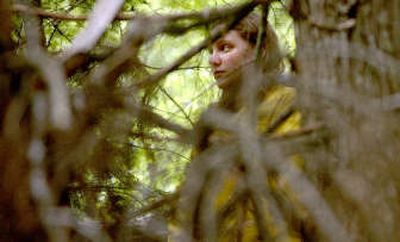
Before T.J. Anderson signed up for Coeur d’Alene High’s advanced forestry management class, the instructor told him he’d never look at forests the same way again.
“It’s kind of a bummer because you can’t enjoy the forest,” T.J. said jokingly Tuesday as he tromped through wet brush in the Sage Creek drainage, twigs popping beneath his feet. “You have to depict it.”
After a year in the school’s forestry program, T.J. said trees are no longer just trees. What was once just a Douglas fir to the teen is now a Douglas fir plagued by disease – a disease he can diagnose with a quick glance.
Students in Lori Frank’s forest management class have spent the past year managing 14.6 acres of forestland east of Silverwood Theme Park. The property is owned by Stimson Lumber, which donates acreage each year for the forestry students to use. Students spend the school year developing a management plan, which Stimson implements. The company gives a quarter of the proceeds from the timber harvest back to the school’s forestry program.
Last week, students presented their management plan to company representatives. Tuesday, students went on-site to mark trees for harvest.
T.J. and classmates Erin Bills and Kolby Clarke were assigned to mark off a riparian area – an area with a natural water flow not far beneath the squishy forest floor.
They used orange tape printed with the words “Stream Management Area” to create a boundary around the sensitive area so it won’t be disturbed by machinery and logging equipment. The trio consulted a hand-drawn map often and stopped every few minutes to debate how the map should be read.
“North is that way, right?” Kolby said, pointing up a hill.
“North is that way,” T.J. said, pointing an entirely different direction.
After much confusion, the students discovered that some of the flags marking different sections of the 14.6 acres weren’t where they were supposed to be. What they were seeing didn’t match the map.
“You need to do some of what the map says and do some of it so it’s right,” Kolby said.
Students spent more than 80 hours in the field for the class, Frank said during last week’s management plan presentation. That doesn’t count the many hours students have put in outside of school doing homework, she said.
This is the first year that students can earn three college credits through the University of Idaho by completing the class, Frank said. She said the full-year program moves at a “fast and furious pace.”
In their presentation, students told how they bored into trees for core samples and counted rings to find out how old the trees were. They told about the different types of root rot and the causes of each. They presented meticulously drawn maps, detailed the types of soils in the 14.6-acre unit, described the wildlife that live there and issued a prescription for the health of the forest area.
“It’s important you limit destructive logging practices,” student Maile Yeats said, describing how areas of the unit were vulnerable to erosion.
The students’ management plan called for logging grand fir and Douglas fir in one area and planting ponderosa pine, white larch and white pine. In another area, students wanted to spray to kill off brush so tree seedlings wouldn’t have competition.
They wanted to cut many trees in another area, leaving a few to protect growing seedlings. The riparian area should be left alone, they said.
“I think they did outstanding,” said Dwight Opp, a fee land manager for Stimson. “They’ve absorbed a whole lot of technical information. For a high school class, it’s simply outstanding.”
One of Frank’s former students has gone on to work for the company as a forester. Other students have gone into forestry, as well. Some have focused on environmental issues and one former student became an environmental lawyer, Frank said.
Students sign up for the class for many reasons, Frank said. Some love the outdoors, some are looking for a career, and some want the college credit.
“Nobody takes it because it’s an easy class,” she said.
Students hike in on snowshoes in the winter. They work in the rain and in the cold. As the year goes on, Frank said it’s fun to watch students grow to love the outdoors and learn to dress appropriately.
“A lot of these kids have never been in the outdoors,” Frank said. “They’ve been to Farragut State Park.”