
Police dogs poised

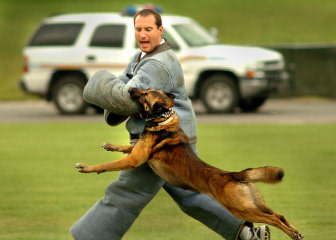
POST FALLS – An 80-pound German shepherd can scale a teeter-totter and gracefully descend on the other side. But the feat requires poise and practice.
Many K-9 cops struggled on the teeter-totter portion of their agility test Saturday at the Greyhound Park and Events Center. Toenails slipped on the slick surface. Dogs slid back or became unnerved by the sudden movement.
But the skill is a valuable one for police dogs to master. Someday, they might be chasing suspects over uneven or shifting ground.
“They learn to perform under pressure,” said Tim Green, a K-9 handler with the Twin Falls Police Department.
The Kootenai County Sheriff’s Office hosted the annual K-9 training and certification trials this year. Nearly 80 dogs and handlers from three states were in town last week for the training. Saturday’s competition was a chance for dogs and handlers to show off what they learned.
Police rigs filled the Geyhound Park’s parking lot. Excited dogs barked from the back seats, while they waited their turn to wriggle though a pipe – a simulation for searching crawl spaces – hurdle over obstacles, or bite an officer in a protective body suit upon command. Another event tested the dogs’ courage. Evaluators sprayed water at the dogs to see if it would deter their pursuit.
The scene was a little bit like eager kids at a soccer tournament.
“It’s like going to Disneyland for the first time every time he gets out of the car,” Rick Van Vooren of the Twin Falls Police Department said of his Belgian Malinois. “If he gets a chance to embarrass me, he will.”
One dog was disqualified for pooping on the grassy field during competition. It’s a sure sign of stress, other K-9 handlers explained.
In addition to athleticism, competitions are designed to increase the dogs’ confidence.
“It’s just like humans,” said Keith Hutcheson, Kootenai County’s K-9 handler. “You’ve got to keep practicing.”
During the prior week’s training, the dogs jumped out of a boat and swam to Tubbs Hill to apprehend a “suspect.”
They also trained under gunfire, which is particularly hard on their sensitive ears.
Most of the dogs on the field were German shepherds or Belgian Malinois. They’re two of the most common breeds for police work. They’re high-strung dogs, with the drive to both play and pursue, Hutcheson said. They’re also persistent, a quality necessary for tracking and narcotics detection.
Departments pay up to $12,000 for a high-caliber dog.
The dogs go through 18 to 24 months of basic training before they’re allowed on the street. Many don’t make the cut.
Small departments, in particular, need versatile dogs with good temperaments, said Andy Johnson, a K-9 handler with the Boise Police Department.
“You might do an apprehension in the morning and a school or Cub Scout appearance in the afternoon,” Johnson said.
Working with a K-9 cop makes their jobs easier, officers said. Van Vooren has never had to issue a “bite” command. The dogs command so much respect, he said, that suspects usually comply with his orders.
The teamwork and bonding that develop between dogs and handlers is extraordinary, officers added.
“They’ll do anything for you if you take care of them,” Green said. “They say you’re married to your dog, and you are.”