
Will real Beltre please step up?
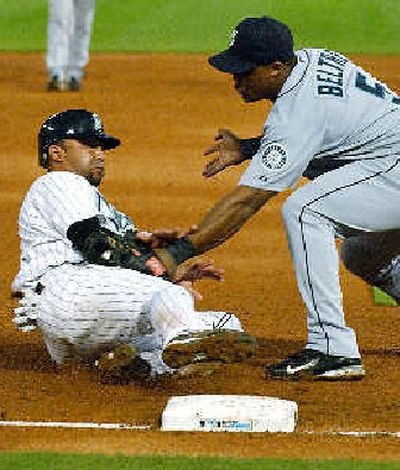

SEATTLE – Once or twice a week, Cesar Izturis calls his old friend, who has moved to Seattle.
The shower head is still spraying hits, Izturis tells him. The old house in Pasadena, Calif., is still furnishing confidence. The locker is still a place to store good at-bats.
Adrian Beltre manages a smile.
When he left Los Angeles this winter, he bequeathed them all to his young former teammate – the lucky place in the shower room for which Beltre, a towel drawn around his waist, would wait unwearyingly after games, the rental place north on the Pasadena Freeway, the narrow cubby hole near the front door of the clubhouse.
In his seventh and final season with the Dodgers, those things, along with a fresh appreciation for the expanse that opens to the right of second base, helped bring Beltre to the brink of the National League’s Most Valuable Player award.
He was second to Barry Bonds, then turned that newfound cache into the richest contract in the history of the Seattle Mariners. In a few months’ time Beltre stepped out of the shower, moved out of Pasadena and packed up his locker. Izturis moved in. And moved in. And moved in.
“He calls to tease me about it,” Beltre said. “And every time I turn on the television, he’s got two more hits.”
What Beltre wouldn’t give for two more hits.
In the early evening before another baseball game, his batting average is almost 100 points from where it was in October. He hasn’t hit a home run in almost two weeks. He is on a pace to drive in 85 runs.
On the shores of Elliott Bay, in the massive steel and brick structure near the intersection of Interstates 5 and 90, along Edgar Martinez Way, Beltre has had another slow start. But it isn’t simply the first two months of a season, but the first 57 games of a five-year, $64-million responsibility.
From a new shower stall, a golf-course community home, a wood-paneled locker, Beltre introduced himself to teammates, met the batting coach, clocked his route to Safeco Field and flied to the warning track a few times. The unfamiliar teammates and bosses tell him not to worry, and the fans do not boo, and the losses are not his alone.
So, he tries not to worry. He thanks the nice people when they gush, “Welcome to Seattle!” He watches videotapes in which he wears another uniform and stands in another batter’s box and hits 48 home runs. For the life of him, he can’t see the difference.
“I’ve been able to handle it, even though, to be honest, sometimes I feel so down because I feel like I’m letting everybody down here,” he says.
He is no longer a Dodger, having chosen the Mariners’ more lucrative contract offer. So, he plays from near the bottom of the American League West, under persistently gray skies, bearing a Puget Sound chill he can’t seem to shake.
The city’s landscape is impossibly green and soothing. The ballpark is one of the gems in the game. The franchise, which last season lost 99 games, driving it to invest $114 million in Beltre and Richie Sexson, is apparently committed to something better.
Then they had to play the games. Bullpen doors opened and pitchers Beltre had never heard of walked through. He lost the outside portion of the strike zone. Baseballs stopped finding the barrel of his bat. He squeezed tighter, swung harder, fell deeper.
“Sometimes I sit in my house and say, ‘Why am I not enjoying life? Why am I not happy? I have everything I can ask for,’ ” he said. “Sometimes you don’t get it, because you care about it. I care about the score, and I care about this team here, and these people here. They trust me to come here and …”
Beltre turned 26 in April. Depending on the view, 2004 was his breakout year or a fluke, a coming-of-age or a one-time-only contract run. Either way, it was on Beltre’s back that the Dodgers won their first division title since 1995 and their first postseason game since 1988.
Then he left his city, his organization, his teammates. The Dodgers, he said, made the decision for him.
He moved his wife Sandra, who grew up in Los Angeles, and his year-old daughter, Cassandra, to Seattle.
Beltre pushes the long view. The season is six months, not two. The contract is five years, not one. Then four more at-bats fall away.
“If I have a bad game or we lost or whatever, I go to the house and just look at the ceiling,” he said. “When I go back to the house and my wife is here, that helps me a lot. I can play with our baby, and she’s the right age to play with her. The next day, you come here and it’s the same thing. Sometimes it’s not fun. Sometimes I hate baseball.”
He shrugs and grins, as if to say, “It will be OK.” It is almost convincing.
“Sometimes I don’t really enjoy this game,” he said. “The failure. Sometimes when you’re not doing good and the team’s not doing good you have no reason to be happy. I mean, inside of baseball. When you’re doing good and the team’s doing good, you can’t wait to come to the ballpark. Last year, I couldn’t wait to get to the ballpark. Sometimes here I don’t want to come to the ballpark.”
The hitting coach, Don Baylor, remembers those feelings well. He was once there, an expensive free agent in a lineup that needed him badly. So he dotes on Beltre, as much as he can. But Bret Boone is in another slump, and Sexson is so frustrated he has heaved his bat all the way to the dugout after a strikeout, and the Mariners are 12th in runs in a 14-team league.
Baylor rubs his head wearily. It’s a big job, and they’d scored just one run against the Tampa Bay Devil Rays. Beltre had singled to get his average to .238. He’d been hit by a pitch too, to get his on-base percentage to .269.
“I had gone through the same thing as a free agent,” Baylor said. “It’s years ago, yet it’s the same pressure. When you go to a new team, you want to impress. That’s always in the back of your mind Yeah, we’ve all been there. You play the game long enough, it happens. But you keep going.”
Beltre is convinced he ran off course during his first games at Safeco Field, when balls he believed would have landed in the Dodger Stadium bleachers were instead warning-track outs. He said he “juiced” a few swings after that, straining for 10 more feet. That’s when pitchers went to the far side of the plate, soft and tantalizing, like they did when he was younger. He lost right-center and right fields, and the swing that got him there. Weeks later, he continues to search.
“To his credit,” Boone said, “he hasn’t shown it. He comes to the ballpark the same guy every day. He’s smiling. He’s happy. He expects good things to happen. If you can do it once, you can do it again. You gotta have ability to do what he did.”