
Barn in the gulch
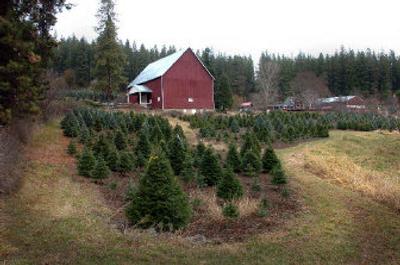
Situated above the Cougar Gulch Road and visible from U.S. Highway 95 is a fully restored red barn that has seen a lot of history.
Don and Peggy White bought the barn along with the farmhouse and 40 acres in 1951 and, records show, have owned the property longer than any previous owner. Don White says that they have been told that theirs is the oldest barn in the gulch – something the couple believes is entirely possible.
The barn was in sorry shape and missing its doors when the Whites moved to the gulch. While working on the building, Don White found half of one pair of doors with writing on it, recording the dates 1884 and 1885 and the prices of hay, barley and wheat for those years.
The Whites have been told that the barn originally was used to stable the horses used to log the surrounding area. Some people speculate that the farm may also have been a way station in the early days because the old Wagon Road wound along the contours of the hills just below the barn.
Standing on the porch of the house, Don White points to the barn roof where a slight dip is evident in the center of the ridge line. He says that the barn was almost broken in half because the vertical supports had rotted away, allowing the center to collapse about four feet.
Peggy White says her husband did all of the restoration work himself. With degrees in engineering, forestry and geology he had the required expertise.
On a tour, he explains the barn is 40 feet wide and 80 feet long. “It’s 50 feet to the peak of the roof.”
Almost all of the 12-inch, squared-off larch timbers that make up the skeleton of the building are original. They were cut long ago from the surrounding forest, hauled to the site by team and shaped by hand. The beams bear the rough marks of the adz used to shape them.
Don White shows us where he jacked up the building, removed the rotted wood from the base of the support timbers and poured concrete footings to replace the wood. The floor also needed replacing and, for this, bought 2,000 board feet of flawed two-by-fours and two-by-10s. To make low-grade lumber usable, he cut out the defective wood and joined together the perfect wood to make a solid floor at a bargain price.
“I paid $25 per thousand for the flooring. Imagine that now.” He said.
On the west half of the barn, the flooring rests on 10 inches of pea gravel, while the east half of the floor is above ground. He also replaced the missing doors, which are in the center of the barn and open on the north and south sides of the building. This allowed a team and wagon to be driven in one side and out the other. The loose hay was unloaded inside and hoisted to the loft with hay forks suspended from a track that ran the length of the building. This arrangement is known as an English barn.
Once the barn was again solid, Don White built 19 box stalls, a breeding room and foaling room for the Arabian horses the couple raised and showed. Peggy White says Carousel Arabians was the largest Arabian horse farm in the country. “We had as many as 70 head of horses here at any time.”
Farther up the hill, to the north and behind the house, is the covered arena where she once trained horses and riders for the show ring. She says there have been horses in her life from the time she was a child. The arena now is rented out for boat storage.
In the mid-1980’s the Whites began gradually replacing the Arabian horses with Christmas trees. “As the horses would leave, we planted more trees,” says Peggy. The Whites kept the name “Carousel,” calling the operation Carousel Christmas Trees.
According to Don White, the business plan is to have 10,000 trees in the ground at all times on a 10-year rotation. This means that each year, 1,000 10-year-old trees are ready for sale, and the forest is replanted with 1,000 new seedlings.
The farm grows a variety of trees segregated into neat plots with names like “Owl” and “Chipmunk.” Probably the most popular tree is the grand fir. “We used to grow Fraser firs, but the deer liked them and ate every one,” said Don White. Fortunately the deer don’t snack on other trees.
The Whites do not sell trees wholesale to tree lots. Families come back year after year, beginning the day after Thanksgiving, to cut their tree. Many come the month ahead to select, mark and pay for their tree.
The Whites take care of the plantation themselves, hand-clipping and shaping each tree. Weeding between the rows is important because, since the Whites do not irrigate, all moisture must go to the trees.
“We don’t have enough water in our well to irrigate,” said Don White. “We used to have two springs, but they are dry now because of low snowfall during recent winters.” He also cites housing developments that tap into the water table.
The day after Thanksgiving is a big day at the Carousel Tree farm. The barn is decorated, and Peggy White, who has a degree in home economics, sells her homemade jams and jellies. She also makes 70 evergreen wreaths she sells. People come back year after year, making the day a traditional family outing. Like proud grandparents, the Whites post a display of snapshots recording those visits.
Peggy White says that for many of their friends – their customers – it’s a kind of homecoming.
The feeling is easy to understand – even after one visit. They greet you like an old friend. A large, woolly dog named Timex – “because he’s a watchdog” – wags a welcome. He has the name-brand wristwatch attached to his collar. A second dog, once badly abused and adopted from a shelter, joins the fun, his past life joyfully forgotten. And there are the three cats – two siblings from a shelter and the third, now plump and round as a pumpkin, who arrived rail thin at the back door one cold night. Her name? Ida, from Peggy White’s response to her husband’s question, “What is it?” she said, “Idaknow.” The Ida part stuck.
We are invited for a cup of tea in the warm kitchen. Outside, a gust of wind blows leaves in yellow clouds from the spreading maple tree, and a couple dozen quail peck at grain spread in the gazebo.
We are in no hurry to leave.