
Updating, expanding
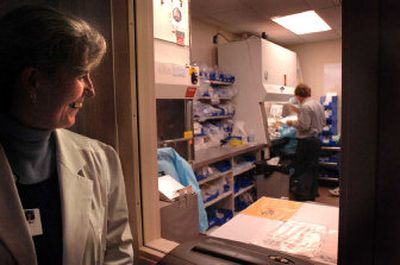
Times have changed since Cindy Johnson began working at Kootenai Medical Center’s pharmacy 24 years ago. Nurses once mixed chemotherapy concoctions on their nursing units’ countertops. Few drugs were available for cancer patients, and side effects were expected to be miserable. Johnson has watched the treatment options multiply, along with increased expectations about workplace safety.
To meet the latest safety requirements while providing cutting-edge treatments to patients, the KMC Foundation decided to designate this year’s Festival of Trees fund-raiser earnings to the North Idaho Cancer Center, where Johnson is now pharmacy manager. An estimated $500,000 is needed to complete the desired updates and expansion. The goal for the 17th annual festival Friday through Nov. 28 at the Coeur d’Alene Resort is half of that sum.
The NICC building plans will allow ample space for mixing drugs and more opportunity and flexibility for patients to receive trials of leading-edge therapies, such as live virus vaccines. Vaccines for lymphoma, pancreatic and prostate cancers are part of the clinical research trials that the NICC participates in to provide options to patients.
“They show great promise,” Johnson said.
The vaccines stimulate the patients’ own immune system to fight their cancer. The difficulty is that many cancer patients who visit the NICC have compromised immune systems. They can’t mingle with the patients receiving virus vaccines.
The obstacle was solved by asking vaccine patients to arrive at 8 a.m., when no other patients are present.
“We have to clean the entire room with bleach,” Johnson said. “It definitely puts on time constraints.”
Besides adding a room to confine vaccine treatments, the NICC plans to purchase new ventilation units or “hoods.” These are needed to whisk airborne particulate matter away from the pharmacy technicians who mix medications. Walls will be knocked down to allow a larger “clean” zone for all medication preparation. An “anteroom” will be attached to the clean room as a buffer zone between areas. Pharmacy workers garb up in masks, hairnets, scrubs and booties before entering that space.
“It will be cleaner than most OR (operating room) suites,” Johnson said.
Although Johnson believes the room they use now is very clean, nationally, there have been some cases reported of patient infections from medication handling, so regulations are becoming more stringent.
“Life has gotten a whole lot more complicated,” Johnson said.
But she’s not complaining. She wants the environment to be safer for her staff, too. All of them have been mixing medications for 10 years or more. Johnson teaches safe handling of chemotherapy agents, the potent drugs used to kill cancerous cells.
Employee health risks are similar to the side effects that might be seen in patients.
Exposures to staff members can occur through inhalation, ingestion or absorption of drugs through the skin. The new hoods circulate all air outdoors so will be safer for patients and pharmacy staff.
“It’ll be nice to have the added protection,” Johnson said.
Additional space will also allow Johnson to welcome more students into the pharmacy. A partnership with Idaho State University is bringing doctoral pharmacy students to KMC, and Johnson hopes to utilize them for patient support. She imagines they’ll help with patient education and interviewing as well as tracking treatment outcomes.
When Johnson was asked to run the NICC pharmacy in 1997, 30 patients were seen each day. Johnson was the only pharmacist working with one pharmacy technician. Now there are two pharmacists, five technicians and more than 160 patient visits daily.
Patient responses have changed for the better, Johnson said. Newer drugs have fewer of the side effects that patients expect, like nausea and vomiting. The drugs are designed to target cancer cells more selectively and leave the healthy cells alone. Patients continue to come to the cancer center thinking that unpleasant symptoms are inevitable, but Johnson counsels them that improved treatments are available if they occur.
“We’re trying to teach patients if they get sick, they need to let us know,” she said.
Johnson’s gratification comes from success stories. Patients do recover and offer the NICC staff members their thanks. But even when a patient doesn’t make it, Johnson feels satisfaction in knowing that new treatments allow patients to experience hope, where before there may have been none.
“Hopefully, you’ve helped them have a better quality of life,” she said.