
When TV was King
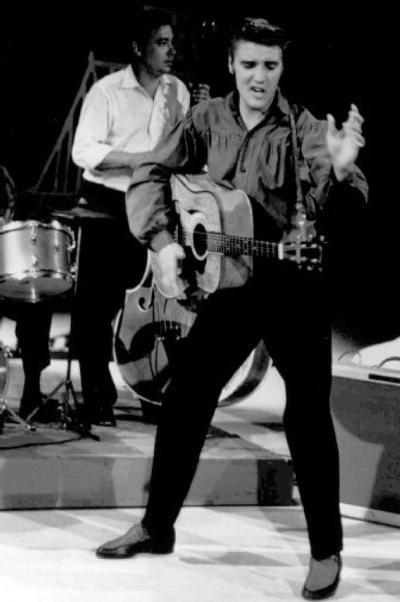
Fifty years ago, as Elvis Presley was about to make his first appearance on “The Ed Sullivan Show,” Helen Kreis was staring at the TV screen, barely able to contain her teenage excitement.
Then her father pulled the plug.
“He was just joking, but before he could get it plugged back in, I was next door at the neighbor’s house. They were watching Elvis, of course, and I wasn’t taking any chances,” says Kreis, 65, of Olney, Md.
“Everybody was watching Elvis.”
Well, maybe not everybody, but nearly everyone in America who had a TV had tuned in. Presley’s first of three appearances on Sullivan’s show, on Sept. 9, 1956, drew 60 million viewers – more than 80 percent of the national TV audience.
It was the high point in the year that was the defining period for Presley’s move from regional celebrity to national icon, and it created one of the first great moments in the history of American pop culture.
“This was a chance for him to really prove himself to the country,” says Andrew Solt, producer of an upcoming set of DVDs marking the 50th anniversary of Presley’s appearances on the “Sullivan” show.
Elvis fans from around the world were in Memphis, Tenn., this week for the annual remembrance of his death in 1977, and many still remember the year he lit up American televisions.
“Other singers just stood there and sang, and then all of a sudden, you’ve got this guy up there going all over the place,” says Diane Adams, 68, of Florence, S.C.
In those days, few homes had more than one television, so millions of star-struck teenagers watched the show with their parents – making the Elvis experience a family event and giving parents a look at what all the hoopla was about.
By today’s standards, Presley looked tame on that first “Sullivan” show in his plaid jacket and opened-neck shirt. He was cool, for sure, with a sly, curled-lip smile, but hardly threatening.
He had already been on national TV several times in 1956, but none of the earlier programs carried Sullivan’s wide appeal and all-American stamp of approval.
Presley’s first No. 1 hit, “Heartbreak Hotel,” came out in January 1956, and his first album, also a chart topper, was released in March. As his fame grew, so did the vigor of his critics, who saw the singer as an oversexed enchanter leading American teenagers to ruin.
But when Sullivan praised him as a “decent, fine boy,” much of the storm began to subside.
The comment came at the end of Presley’s final “Sullivan” show on Jan. 6, 1957, when he was shown from the waist up only. (Sullivan, recovering from injuries suffered in a car crash, missed Presley’s first appearance; famed actor Charles Laughton hosted that show.)
Presley’s first six TV appearances in 1956, in January and March, were on “Stage Show,” hosted by bandleaders Jimmy and Tommy Dorsey. He also performed twice on “The Milton Berle Show,” in April and June, and on “The Steve Allen Show” in July.
Following his “Berle” appearance, Presley was savaged by critics who described his leg-shaking, hip-swiveling performance as “noxious” and his singing as “caterwauling.” Often the criticism had a racist edge, since Elvis was singing what was considered “black music.”
One critic, notes Elvis biographer Peter Guralnick, summed up Presley’s performance as “the kind of animalism that should be confined to dives and bordellos.” A Catholic weekly ran its criticism under the banner, “Beware of Elvis Presley.”
So Allen vowed to keep Presley under control. He put the future king of rock ‘n’ roll on stage dressed in a tuxedo and singing his yet-to-be-recorded “Hound Dog” to a basset hound.
Presley was not pleased and referred to the hound as “that damn dog,” says Gordon Stoker of the Jordanaires, the quartet that backed Presley for almost 15 years.
“We were never again to mention that show to him – and we didn’t,” Stoker says.
The “Allen” show also included a “Range Roundup” skit, with “Tumbleweed” Presley sporting a cowboy hat and big bandanna.
“They just didn’t know what to do with him,” Stoker says.
Describing Presley as “not my cup of tea,” Sullivan had vowed not to have him on his show. But when Allen’s ratings went through the roof, Sullivan had a sudden change of heart.
He paid Presley the unheard-of sum of $50,000 for the three shows. Presley got $1,200 each for his first TV performances and $7,500 for the Allen show.
Presley believed the “Sullivan” show could make or break his career, Stoker says. He was nervous and didn’t want to feel alone on stage.
“He had us stand just as close to him as we could stand,” says Stoker. “We were so close that when he would move back, he would step on our toes.”
Pre-show jitters were nothing new for Presley.
“He was always nervous when he went on stage, and his heart was racing for hours after he’d perform,” former girlfriend June Juanico recalls. “That adrenaline rush probably contributed to his heart giving out because that was some powerful adrenaline he had.”
Presley died at age 42 on August 16, 1977, after years of prescription-drug abuse. The cause of death was listed as heart disease.
Juanico of Biloxi, Miss., dated Presley through much of 1956, and he phoned her after the first “Sullivan” show.
“He wanted to know, ‘How did I do?’ And I said, ‘You were wonderful,”’ Juanico says.
“He said, ‘I didn’t sound like that country boy from Tennessee?’ And I said, ‘No you were absolutely marvelous.’ “
The upcoming “Sullivan” DVDs, to be released in November or January, will offer a new perspective on Presley since they’ll contain complete broadcasts rather than clips of his performances, says producer Solt.
Presley shared the “Sullivan” stage with acrobats, tap dancers and clowns.
“It was the average variety show of the day,” Solt says, “and then a guy named Elvis walks out there and he’s radiant and he’s larger than life and he just stands out.”