
Weighty film topics abound
Homophobia on the range. Homicide in the Midwest. Terrorism in the Mideast. Racism in L.A. Witch hunts in D.C.
And the fun doesn’t stop there.
The five best picture nominees announced Tuesday for the 78th Academy Awards aren’t exactly rife with mirth and merriment.
Doomed cowboy love in “Brokeback Mountain,” cold-blooded murder in “Capote,” hostage-taking and assassination in “Munich,” urban rage and dread in “Crash” and government fear-mongering in “Good Night, and Good Luck” are just a few of this Oscar season’s breezy topics.
The Academy Awards have long been the place for Hollywood to put on its serious face and recognize issues of social significance and historic import, but this year’s batch abounds with especially somber and portentous themes.
“Brokeback Mountain,” which received a leading eight total nominations, is a heartbreaker of a romance that is making grown men – and women – cry.
And look at these acting nominees: Joaquin Phoenix’s tortured, drug-addled Johnny Cash in “Walk the Line”; Terrence Howard’s Memphis street hustler in “Hustle & Flow”; Heath Ledger’s tragically closeted gay sheep-herder in “Brokeback”; Felicity Huffman’s emotionally damaged sex-change candidate in “Transamerica”; Charlize Theron’s abused, humiliated mine worker in “North Country.”
Maybe that’s why Judi Dench landed another undeserved nomination – for the totally forgettable “Mrs. Henderson Presents,” about a society dame who starts a nude stage revue in 1930s London – because it’s such a relief to encounter something so weightless among all the angst and despair.
Depending how you look at it, this year’s crop of Oscar nominations also represents the further indie-fication of Hollywood – or at least the studio co-option of what’s widely perceived as independent fare.
Aside from Steven Spielberg’s “Munich,” the best picture nominees are all low-budget affairs (under $15 million) distributed by the specialty art-house divisions of their studios – or, in the case of “Crash,” by an authentic independent (Lions Gate).
The other big-budget movies on the best-picture radar – “Walk the Line,” “Memoirs of a Geisha” and “Cinderella Man” – were passed over.
The year’s biggest hit, “Star Wars: Episode III – Revenge of the Sith,” earned a nomination for best makeup but was shut out otherwise – including the visual-effects category, a blow to the George Lucas franchise that has pioneered special effects.
And “King Kong,” directed by Peter Jackson (“Lord of the Rings”), earned only technical nominations.
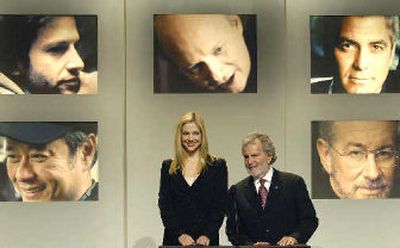
The director nominees also are telling. Three of the five are novices: Bennett Miller, an actor-turned-filmmaker, for “Capote”; Paul Haggis, a screenwriter (and previous Oscar nominee for his script for “Million Dollar Baby”), for “Crash”; and George Clooney, for his sophomore directing job, “Good Night, and Good Luck.”
Ang Lee (“Brokeback Mountain”) and Spielberg are the sole old pros in the bunch.
Speaking of Clooney, he pulled off his own feat, garnering four nominations – director, screenwriter, supporting actor and producer of a best picture – tying a record held by Orson Welles for “Citizen Kane.”
In addition to three nominations for “Good Night,” Clooney received a supporting actor nod for the Middle East spy thriller “Syriana,” in which he plays a harried CIA operative – making him the first person to receive acting and directing nominations for different movies.
Jon Stewart, wise-acre anchorman of “The Daily Show,” will host this year’s Oscars on March 5 from Hollywood, and it could be a good fit.
Night after night on Comedy Central, Stewart manages to make viewers laugh over the world’s worst travails: war in the Mideast, threats to the Constitution at home, blunders in the White House and hypocrisy in the media.
If anybody can make “Munich” funny, he can.