
Backyard chickens gaining popularity
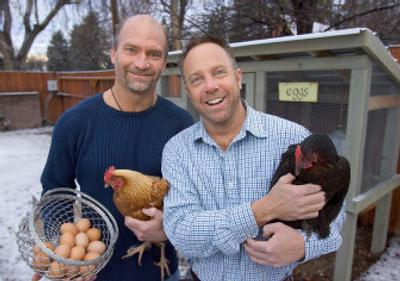
BOISE – Susan Medlin remembers the day she started really paying attention to chickens – live ones, not the ones wrapped in plastic in a supermarket case.
It was 2003. Medlin and her husband were helping a friend paint her house, and the friend’s half-dozen chickens were doing what chickens do: scratching around in the yard, clucking and interacting with the world in a friendly, if wary, sort of way.
“I started really enjoying their rather complex interactions,” said Medlin. An enthusiastic cook and a proponent of sustainable agriculture, she immediately started looking into the world of chicken-raising. She learned that chickens can live in urban backyards, producing eggs, eating bugs and providing pet-like companionship.
Now Medlin’s gone into business producing mail-order backyard chicken coops – raccoon-proof structures made in Idaho and fit for almost any urban setting.
Backyard chickens aren’t new; Martha Stewart has extolled the benefits of keeping a few chickens for the eggs, and urban chickens have been reported in most major cities.
Portland is known as something of a hot spot for urban chickens, and owners get together there to swap tips.
“It has started to become easy to get information and support,” said Kirsten Cutts, of Portland, who acquired her three chickens earlier this year. Portland has mild winters, which helps – and sustainable agriculture is nothing new there.
Sprawling Boise continues to expand, and all kinds of livestock live within the city limits. Downtown, up to three chickens per lot are allowed.
Roosters are banned.
“Roosters have a tendency to disturb the neighborhood when they start doing their crowing,” said Scott Brown, a code enforcement officer for the city.
Dan Searle keeps three red chickens in the small, fenced garden of his downtown Boise home. Each one lays about one egg a day; he frequently gives extra eggs to his neighbors.
“Anytime you know exactly where something comes from, it’s better,” he said. “And the experience for the chicken is better.”
Searle doesn’t let the chickens roam his yard. Chicken proponents sometimes say the poultry are useful at removing garden pests, but Searle said his chickens would strip his vegetable garden in minutes if they got a chance.
Chicken-keeping also teaches children about the cycle of life, said Medlin.
“It’s a pretty wonderful thing for a child to understand: that other creatures make it possible for us to live well,” she said. And “as with all animals, it teaches children to try and understand behaviors that are not their own.”
When they’re raised by hand, chickens can be trusting and friendly, allowing children to pick them up and carry them around. They don’t harm anyone; when they’re scared, they dash away. And kids love running to the chicken coop in the morning to see if there are fresh eggs.
Chickens eventually stop laying eggs. At that point, some people keep them as pets; some people stew them.
Medlin, a former teacher and co-founder of a private school, doesn’t expect to get rich producing backyard chicken coops. But the business fits in with one of her goals in life: helping people find healthier, more local food.
Having your own chickens is “a different sensibility than buying things at Albertson’s that have come 2,500 miles and are packaged to death,” she said.
Searle, who flies all over the world as a purser in charge of flight crews for Northwest Airlines, sees chickens as a connection to his rural past.
“My grandmother and grandfather owned the largest hatchery in South Dakota,” said Searle, 42, a California native. “I’ve had chickens ever since I was 7 or 8.”
You probably wouldn’t want more than the three chickens that Boise allows in a small backyard. Chicken coops have to be cleaned frequently and must be locked up at night to keep predators at bay.
Medlin’s coops are made of quarter-inch powder-coated aluminum and cost $600 apiece.
“You don’t want some ramshackle chicken coop in your backyard; it doesn’t look very nice,” she said. Besides, “The more control you have over your food, the better you will eat.”