
President condemns rioting
WASHINGTON – President Bush condemned the deadly rioting sparked by cartoons of the Prophet Muhammad on Wednesday, and his secretary of state accused Iran and Syria of trying “to inflame sentiments” across the Muslim world.
Bush urged foreign leaders to halt the spreading violence and to protect diplomats in besieged embassies.
This was the first time the president has spoken out about the controversy, signaling deepening White House concern about violent protests stemming from the publication of caricatures in Denmark’s Jyllands-Posten and reprinted in European media and elsewhere in the past week.
“We reject violence as a way to express discontent with what may be printed in a free press,” Bush said.
At the same time, he admonished the press that its freedom comes with “the responsibility to be thoughtful about others.”
Bush made his comments while sitting beside Jordan’s King Abdullah II at the White House. Abdullah, too, called for protests to be peaceful, but he also spoke against ridicule of Islam’s holiest figure.
There was increasing talk, in the U.S. and abroad, that some foreign governments as well as extremist groups were fanning the violent protests.
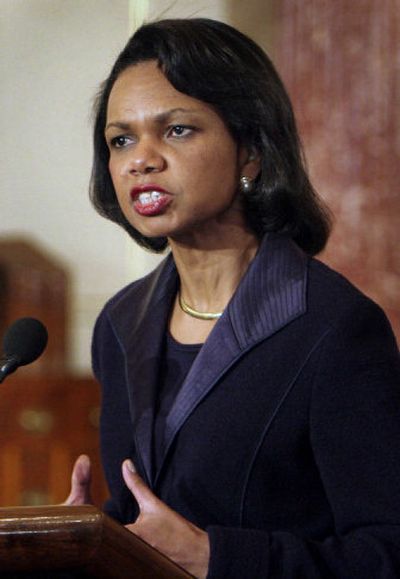
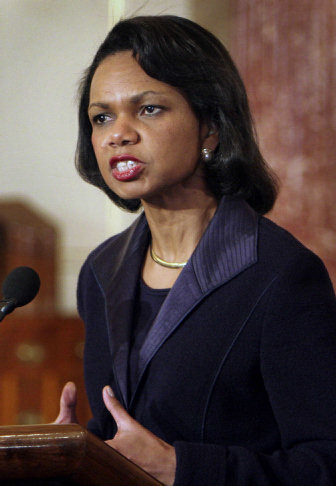
At the State Department, Secretary of State Condoleezza Rice said, “Iran and Syria have gone out of their way to inflame sentiments and to use this to their own purposes. And the world ought to call them on it.”
There is little doubt that there is genuine anger throughout the Muslim world, where images of the revered Prophet Muhammad with a bomb strapped to his head are considered racist and deeply insulting.
In the post-Sept. 11 world, Muslims already feel the brunt of the war on terror and the invasions of Iraq and Afghanistan, said Diaa Rashwan, with the Al-Ahram Center for Political and Strategic Studies in Cairo, Egypt.
“That only further fueled the anger this time around,” he said, the cartoons releasing bottled-up anger and frustration.
In the midst of a campaign to blunt widespread anti-American sentiment across the Middle East, Bush sought to balance his remarks by urging the media to be sensitive to religious beliefs.
“We believe in a free press,” Bush said. “We also recognize that with freedom comes responsibilities. With freedom comes the responsibility to be thoughtful about others.”