
Older students arrive on TV’s campuses
When executives from the WB started thinking about a new student drama that would mirror the lives of their 12- to 34-year-old audience, they bypassed the traditional standby, high school.
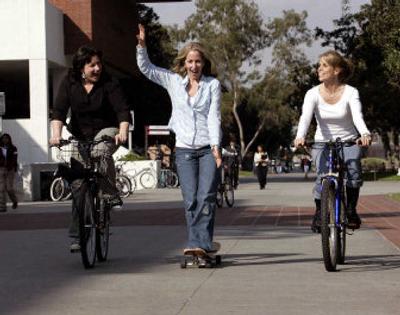
So did the creators of Oxygen’s new comedy “Campus Ladies,” who sought a setting for adults who dream of recapturing their youth.
And at Black Entertainment Television – where the top-rated show, “College Hill,” follows the lives of eight university students – executives are keenly aware that college is fast becoming TV’s new high school.
For decades, pop culture has relied on the rule-bound, awkward and frustrating high school years as the foundation for iconic coming-of-age movies and shows such as “Fast Times at Ridgemont High,” “Dazed and Confused” and “Beverly Hills, 90210.”
But lately, the scene is shifting to the college campus, where freedom is new, identities take shape and the possibilities for danger and frolicking – not to mention notes from censors – are boundless.
Where high school shows focus on the gawkiness of the half-child/half-adult, college represents “the prime moment of fun,” says Evangeline Morphos, Columbia University professor and consulting producer on the WB’s “Bedford Diaries,” an ensemble drama that will debut in March.
“You’re liberated from your parents, you’re liberated from pimples. You come into the person you are.”
College is “the reward for surviving high school,” says director Judd Apatow, creator of 2001’s one-season comedy “Undeclared,” about a college freshman whose father moves into the same dorm. “Most people have great fun stories from college and nightmare stories from high school.”
And yet, compared with the many successful high school shows – “Buffy,” “The O.C.,” “Veronica Mars” – it’s hard to think of a successful college show since “Felicity,” a romantic and idealized view of college life that ran from 1998 to 2002.
“Undeclared” and “The Education of Max Bickford,” network shows set on college campuses, came and quickly went in 2001 to 2002.
It’s not for lack of interest: “College Hill,” a reality show featuring students at historically black colleges, has been the top-rated show at Black Entertainment Television since its debut in 2004. The third season premieres March 2.
“One reason for the dearth of college shows is that it’s difficult to be honest about campus life on network or basic cable,” says Apatow, who also directed the feature film, “The 40-Year-Old Virgin.”
“It’s hard to portray truthfully. The truth is, kids are high, drunk and having sex. No matter what you do, you’re fudging it.
“People tend to not want to see young people make enormous, shocking mistakes, but that’s what happens. It’s part of that experience.”
Robyn Lattaker-Johnson, BET’s vice president of development, says Virginia State University, featured in Season Three of “College Hill,” had minimal control over the production, limiting casting to students with good grades.
“It is the reality of college life. We didn’t have to leave out that much,” she says.
Later this year, BET will debut a docudrama, “Season of the Tiger,” that looks at Grambling State University’s football team and marching band.
The creators of “Bedford Diaries” say their mission is to provide as honest a picture of college life as censors will allow.
“The hope is that it is the ‘Felicity’ for the new generation,” says David Janollari, president of entertainment for the WB.
“The notion is to be as real as possible. The intent is to be as provocative as possible in the context of broadcast standards.”
In “Diaries,” some students have been through alcohol recovery programs or suicide attempts. Their common denominator is a human sexuality class in which they are asked to record their thoughts in video diaries.
Morphos, says the idea was vetted by Columbia’s administrators, who considered the premise feasible. Most colleges have sexuality classes, she says, adding that many college newspapers have student sex columnists.
The sexuality class serves as a springboard to talk about not just sex, but “lifestyles and choices,” says writer Tom Fontana. The professor “wants the kids to ask tough questions as opposed to blindly going through life without examining their lives.”
Clearly, an ever-increasing percentage of the population can relate to campus life, either as a former college student or as a returning adult.
“More people are going to college in all age groups,” says John Lee, consultant to the National Educational Association. Of the 17.4 million college students enrolled in 2004, 38 percent are older than 25, he says.
The majority of adults returning to college are trying to improve their chances of career success, Lee says. While older students might want to join the social life, many are struggling with jobs and families and barely have time for the classwork.
Nevertheless, there’s always a longing for youth, says Carrie Aizley, co-star with Christen Sussin of “Campus Ladies,” a comedy about fortyish singles enrolling and living in a coed dorm on campus. (It airs numerous times throughout the week on cable channel 50 in Spokane, 64 in Coeur d’Alene; see local listings.)
It was when she was sitting home with her first child watching “Felicity” reruns that Aizley started to think she might have missed something in her days at Boston University, where she always went home on weekends and didn’t join the party crowd.
In the show, she and Sussin try fruitlessly to blend in at keg parties, spring breaks and sorority rush and find themselves accused of date rape, hung over or in a Mexican jail.
“We can’t believe how much fun it is,” says Aizley, poised to embark on a second season.
Sussin, who recalls going to classes as a University of Southern California student after staying up all night, says she didn’t need to relive her college social life.
“I got my partying out back in the day,” she says. “A huge part of me would love to go back, knowing what I know now. I’d go to town academically.”
Even though students may appear more sophisticated today, much of the appeal of the college shows is that they are, basically, no different from older generations.
“Their problems,” says “Bedford Diaries” writer Fontana, “are the same sort of problems kids have had in college since Socrates.”