
Rural Horror
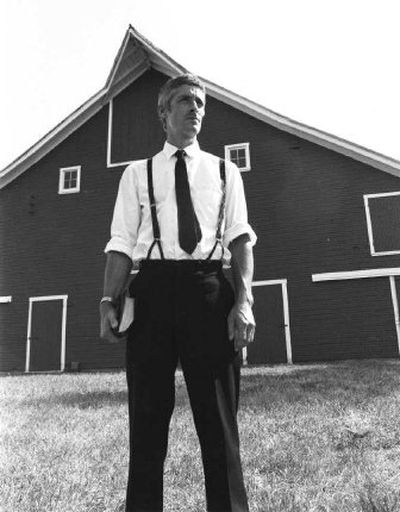
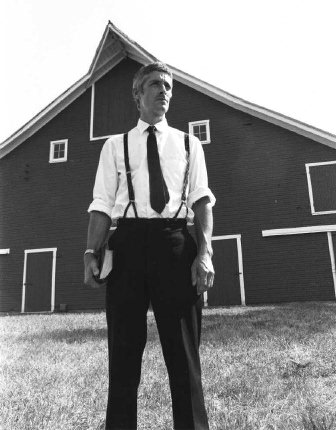
It comes at about minute 26. The scare, that is. Minute 26 marks the moment in the short film “What’s in the Barn?” that is most likely to make you jump. That, at least, is what several audience members did who saw the film during its premiere at the recent Spokane International Film Festival – which made it arguably the most entertaining of the 20-odd shorts that played SpIFF 2006. Not a bad achievement for four Spokane filmmakers and a movie that began as nothing more
than a location and the question that ultimately became its title.
Mike Corrigan had the initial idea. A freelance writer by trade, Corrigan was acting in a film being co-directed by the other three: two guys who work during the day as machinists, Travis Hiibner and Gary McLeod, and graphic designer Derrick King.
They were shooting on a farm near Spangle that a friend of Corrigan’s was housesitting.
“It was really creepy out there, and it just struck me that it would be a great location for a film,” Corrigan says.
The next day, when the crew was wrapping up the day’s shoot, Corrigan told the others his idea.
“All I had was the title,” Corrigan says, “and as soon as I said that, these guys go, ‘Ooooooh, I like that!’ They were like, ‘That’s it. That’s our next project.’ “
Owing a big debt to David Lynch – aspects of his film “Eraserhead” can be seen throughout – “What’s in the Barn?” is notable for several reasons: It’s shot in black and white, it depends largely on ambient noise (the squeak of a swing set, the sound of a car, an incessant and other-worldly hum), it has no dialogue, and two of the four actors do nothing more than sit and stare – at the floor, at the television, at each other.
And then there’s the scare, which comes when the preacher (Jon Swanstrom), who has been stalking the farm like a fox coming off a winter fast, follows the little girl (8-year-old Kate Dinison) into the barn.
Funny thing is, there’s nothing inherently frightening about the farm. But after watching “What’s in the Barn?” you can see what intrigued the four co-directors from the first.
“We went out to the barn over a long weekend and we just walked around and looked,” McLeod says. “We found the table and chairs. We found the hole in the barn. We found the wagon.”
“The swing set,” Hiibner adds.
The next step was to put something down on paper.
“I kind of had a rough idea of what we should do with it,” Corrigan says. “But I didn’t have anything written. We kind of got all these ideas from the location itself. Then we met at Derrick’s house with notebooks and threw out ideas to see what we could come up with.”
All of the film’s stylistic touches, the lack of dialogue, the use of black-and-white film stock, the sound, feel natural. And planned.
But mention all this to the four co-directors and they’ll liable to laugh – not because the statement is stupid but because some of artistic choices are products of … well, let them tell it.
“The ‘no dialogue’ thing was, frankly, because we couldn’t sync the sound,” Corrigan says. “We had no money. So from the beginning, we thought, ‘Let’s do this purely visually.’ “
“Not having money forces you to be more creative, which is not a bad thing,” Hiibner says.
Especially, he says, in a city that’s made for movie moods.
“We kind of work in reverse,” Hiibner says. “We find a unique location, maybe downtown Spokane, and go, ‘God, that’s really cool-looking. Let’s write a story about it.’
“It’s a way to work cheaper,” he adds.
Money, clearly, is always a concern. Corrigan, a 1980 graduate of Gonzaga Prep, gets by on what articles he can sell. And while the other three – Utah native Hiibner, 33, McLeod, 32, and King, 38 – have regular jobs, that doesn’t mean they can afford to spend a lot of money on their films.
Even when you spend only $2,000, which is what they estimate “What’s in the Barn?” cost to make.
And how much do you invest in an avocation, even if it is something you call your passion?
Hiibner and McLeod, who have been friends for 15 years, fell in love with filmmaking – as opposed to shooting on video – after they took a class at the Spokane Art School taught by Rick Pukis (who has since moved to Georgia).
“We’ve always wanted to do some kind of art,” says McLeod, who with Hiibner and others organizes the annual Flicker Fest film festival, which plays in October at CenterStage.
“We’d get a lot of things started but we’d never finish them. And then we made our first film, and it was just like, ‘OK, this is it. This includes writing and painting and acting and sculpting, it’s every art form.’ “
It was in class that they met King. And while making a film with another Spokane filmmaker, Lonny Waddle, they met Corrigan.
“Until I met these guys I’d never run into anybody who motivates me,” Corrigan says. “I thought if I hitched my wagon to these guys I’d actually have something to show for it.”
That much has come true. The foursome has made a second film since “What’s in the Barn?” (titled, of all things, “Jack the Vomiter”), they’ve got yet another project in the works and a number of plans beyond that.
But it’s the reception that “What’s in the Barn?” received at SpIFF that has them excited now.
Maybe, they think, they can find other venues, other festivals, at which to show their little exercise in rural horror.
“I just think we’re doing some cool stuff, and I want people to see it,” Hiibner says.
“Yeah,” adds McLeod. “I don’t think we’re going to get rich or famous. But it would be nice to have an audience.”
Especially one that jumps when it’s supposed to.