
An enterprise in cooperation
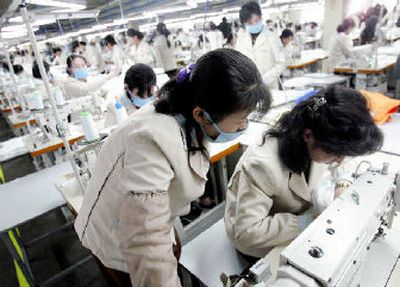
KAESONG, North Korea — Officials from the divided Koreas on Monday showed off a joint industrial zone, a key project they hope to dramatically expand in coming years in a sign of faith that relations between the two states are moving further toward reconciliation.
“We will bring peace and prosperity to the Korean Peninsula through the Kaesong Industrial Complex,” Kim Hyo Jong, a North Korean official serving on the Kaesong Industrial District Management Committee, told foreign journalists.
It marked the first time that non-South Korean reporters from foreign news organizations were allowed to visit the facility, one of the key fruits of a budding detente between the two Cold War rivals.
The communist North and capitalist South have been politically divided since the end of the 1950-53 Korean War, which ended in a truce instead of a peace treaty, leaving them technically at war.
Tensions have eased considerably in recent years, however, particularly after a historic summit between North Korea leader Kim Jong Il and then South Korean President Kim Dae-jung in 2000 fostered increased exchanges and more business deals.
Construction on the Kaesong complex began in June 2003, three years after the summit, and it began operating the following year, led by Hyundai Asan Corp., the Seoul-based company spearheading South Korean business efforts in the North.
So far, a total of 15 South Korean companies have set up shop in this enclave, surrounded mostly by barren hills and dusty fields, less than six miles from the heavily armed border separating the Koreas.
They are shipping manufactured goods ranging from kitchen pots to semiconductor parts to the South, utilizing about 6,000 North Korean workers.
Clothing, footwear and cases for cosmetics are among other products manufactured in the zone, where North Korean workers earn about $57 a month.
Though the project is still in its infancy, Kaesong has already played a major role in boosting inter-Korean trade to historic levels.
Trade surged 51.5 percent in 2005, topping $1 billion for the first time, the Korea International Trade Association, or KITA, said last month.
The value of trade at the Kaesong zone more than quadrupled in 2005 to $176.7 million (euro148.8 million) last year from $41.7 million in 2004, KITA said.
Plans are for zone to host as many as 300 companies by the end of next year when the first phase is completed.
One official acknowledges that goal may be a bit ambitious, but emphasized progress is being made.
“The infrastructure I don’t think is ready yet,” said Byun Ha-jung, a senior manager with Hyundai Asan. “But 300 companies selected, it’s possible.”
Beyond that, by 2012, when the project is complete, officials plan for the zone, which will double in area to 2,720 acres, to house 2,000 businesses.
The city of Kaesong, after which the complex takes its name, was once the capital of all Korea and has a long history as an economic center.
Though steadily rising, the amount of trade with North Korea remains minuscule for South Korea, the world’s 11th largest economy and the home to industrial behemoths like Samsung Electronics Co. and Posco, the world’s fifth-biggest steelmaker.
It’s also far less than that between two other divided political rivals, China and Taiwan, who have fostered intense economic exchanges. Two-way trade across the Taiwan Strait totaled 91.23 billion yuan ($11.3 billion) in 2005, according to China’s Commerce Ministry.
North Korea’s economy grew an estimated 2.2 percent in 2004, the sixth straight year of estimated expansion, as good weather boosted the agricultural sector, according to the Bank of Korea.