
Tsutakawa enriched city’s palette
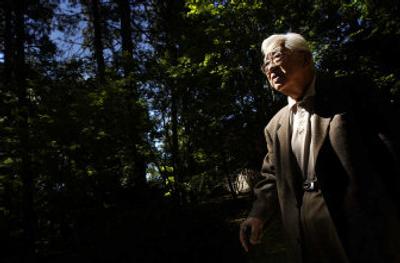
During the early months of World War II, Ed Tsutakawa and his family found themselves interred with thousands of other Japanese at the Western Washington Fairgrounds at Puyallup, then at Minidoka near Twin Falls, Idaho.
Tsutakawa sketched and painted those bitter camps, sometimes in depressing charcoal, sometimes in more cheerful watercolor. One painting — and Tsutakawa is very proficient — depicts a three-ton Dodge truck like one he drove while helping southern Idaho farmers who were desperate for labor because Mexicans were not available. Residents glared when trucks driven by Japanese-Americans first passed through town, he recalls.
But one summer evening, as young internees danced to jazz tunes played by the camp band, they noticed dozens of Twin Falls youths outside, listening. The camp residents invited them in. Barriers fell away to the strains of “Night and Day.”
“The next day our image was completely different,” Tsutakawa says. “We were welcome everywhere.”
He says he has harbored a soft spot for Twin Falls ever since but, then, he harbors a lot of soft spots; for Hawaii; for Nishinomiya, Japan; and, most of all for Spokane. Though opportunities for the Seattle native to leave his adopted city have come along from time to time over the decades, he has never seriously considered leaving.
“Truly, I would have to say Spokane is the greatest place,” he says. “There are great people here.”
Tonight, many of those people will honor Tsutakawa and wife Hide at a Davenport Hotel reception. The list of speakers includes Spokane Mayor Dennis Hession, Spokane Community Colleges Chancellor Gary Livingston, and Spokesman-Review Publisher Stacey Cowles, who is among the many local leaders mentored by Tsutakawa.
Another protégé, Spokane RiverHawks Business Manager Matt McCoy, says Tsutakawa has done more than anyone else to help make Spokane a more cosmopolitan city.
“When we look back in 50 years and try to see why Spokane has become an international community, Ed Tsutakawa will be the one to recognize for that,” McCoy says.
The event is intended in part to raise a $20,000 endowment for a scholarship named for Tsutakawa. The International Trade Alliance awards $500 annually to a student at an Inland Northwest university who is focusing on international business and trade.
Thanks to tonight’s festivities, he says, “It’s amazing how easy it’s been to raise money.”
Even if fully funded, the scholarship endowment would be meager compared with all Tsutakawa has done for the city he moved to in 1944.
Most importantly, he is responsible for bringing the Mukogawa Women’s University to the former Ft. George Wright College campus in 1989. Now Mukogawa Fort Wright Institute, the school has brought thousands of women from the Japanese university’s home campus in Nishinomiya to Spokane for immersion in English language instruction and American culture. They spend millions in the city annually.
In 1961, he had helped forge Spokane’s Sister City relationship with Nishinomiya, where he spent some of his adolescence. He and former mayor Neal Fosseen helped organize Spokane’s response to the earthquake that shattered that part of Japan in 1995. At a memorial for the victims, he was seated right behind Japan’s crown prince and princess as a sign of respect.
Tsutakawa’s other major contribution, and personal joy, is the Japanese Garden at Manito Park, which opened simultaneously with Expo ‘74. Although he considers the arch over the reflecting pool too big, he notes many consider the garden among the finest of its kind in the Northwest. He has his own key, and used to visit every day.
As he nears age 85, kidney dialysis has slowed Tsutakawa somewhat, but he’s planning a trip to Hawaii soon, and another to Japan in the fall with the trade alliance. Going to Japan with Tsutakawa, McCoy quips, “is like going to the North Pole with Santa Claus.”
Still a senior adviser at Mukogawa, Tsutakawa says he has always tried to share his knowledge with others, as mentors like Fosseen and former Whitworth College President Ed Lindaman did with him years ago. Sharing, he says, can have a magical effect, as it did on a summer’s night more than 60 years ago at Minidoka.
“I really do everything I can to create a better place to hand over to future generations and the community,” he says. Tonight’s tribute will be an pleasure not for the recognition he will receive, Tsutakawa says, but for the opportunity it will give him to thank all those whom he has worked with in Spokane.
“I have to plainly say that everything I’ve done, I’ve enjoyed.”
Ed, it’s been our pleasure. Thank you.