
Beefing up the bison industry
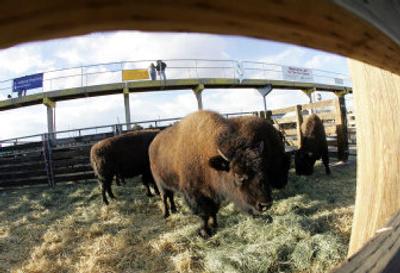
DENVER – The irony of bison ranching isn’t lost on Dave Carter. Helping the once nearly extinct creatures recover has required raising them for slaughter.
The proof is in the numbers, says Carter, executive director of the Colorado-based National Bison Association. About 35,000 bison were processed nationwide last year, up 17 percent from 2004.
More than 250,000 bison are being raised on ranches across the country. The massive, shaggy animals that once roared across the North American plains by the millions were decimated by widespread slaughter during Western growth, dropping to an estimated 1,000 or fewer by the late 1800s.
“As we continue to rebuild the herds and bring the species back from the brink of extinction 120 years ago, it really requires that bison end up on the dinner plate for ranchers to have the incentive to bring the animals back,” Carter said.
Starting in the late 1970s, Carter says, a few ranchers decided that bison deserved to be more than just a novelty limited to a handful of herds in places such as Yellowstone National Park.
Media mogul and bison rancher Ted Turner has helped raise the industry’s profile through his Ted’s Montana Grill restaurant chain, which specializes in bison meat. He has 39 restaurants in 16 states – more than twice the number in 2004.
Still, Carter concedes the bison industry likely will always be only a bit player. Although last year’s total of 35,000 bison processed was a healthy increase, “the beef industry does more than that before lunch,” he said. Roughly 125,000 cattle are processed every day, and the industry is measured in billions of dollars. Carter estimates annual bison sales at $112 million.
The National Bison Association and ranchers have stepped up marketing, promoting bison’s lean meat – about 2.5 grams of fat per 100 grams compared with about eight to 10 grams for beef.
After a bison is killed, 59 percent of its weight typically is edible meat and bones compared with 63 percent of cattle’s weight, Carter says. But bison typically yield more meat because they are leaner.
John Painter, who manages a bison ranch northwest of Taos, N.M., says increasingly health-conscious consumers also like the fact that the animals aren’t given hormones or antibiotics. He says he prefers bison meat for the high iron and low cholesterol.
Roy Rozell, a ranch manager in Steamboat Springs, Colo., says he likes bison for their low maintenance. He doesn’t need – or want – help during calving, he says.
But fences have to be a little taller because bison can jump as high as 6 feet. Chutes and holding facilities have to be bison-tough – a mature bull might weigh more than a ton – and the animals can raise a ruckus when being weighed or examined.
Rozell says, however, that bison are content to stay in place if they have what they want. But he expressed a concern common in the industry: that the intelligence, curiosity and self-sufficiency that make bison so intriguing eventually will be diluted through breeding.
“Nature made them to survive – nature did that for us. We’ll probably screw it up as we keep breeding them,” Rozell said.
“To be out and watching them when they’re running as a herd and they’re blowing through the snow, it’s an awesome thing to see,” he said.