
They’ve never been in the game
DETROIT — Before the Super Bowl kickoff this weekend, private planes will land here, limousines will clog the streets, and lavish parties will be thrown for those with famous names or lots of money. The kitchens of Ford Field will be stocked with two tons of lobster.
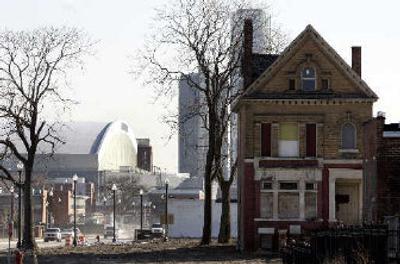
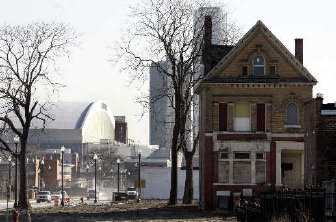
Much of the rest of Detroit, though, is a landscape dotted with burned-out buildings, where liquor stores abound but supermarkets are hard to come by, and where drugs, violence and unemployment are everyday realities.
Officials in the nation’s poorest big city see hosting the game as a huge boost. They say it will be a catalyst for further development and provide a chance to improve Detroit’s gritty reputation. They hope visitors will take note of new restaurants, clubs and lofts downtown. To make sure the city makes a good impression, dilapidated buildings have been torn down, roads repaved and landmarks renovated.
Yet many residents say they have not seen any improvement. And they don’t expect the Super Bowl to have an effect on their lives.
“They spend all that money on the Super Bowl … but they ain’t doing nothing for here,” said Arthur Lauderdale, 59, who lives about four miles from the heart of downtown on Detroit’s east side.
The scenery along Van Dyke Street near Lauderdale’s home would be familiar to anyone who has seen “8 Mile,” Eminem’s movie about life in Detroit. The street’s once-bustling commercial section is dominated by boarded-up stores, charred buildings and vacant lots. The only signs of activity are at storefront churches and the occasional liquor store and hot-dog joint.
That is not to say there are no thriving areas outside of downtown. Detroit has several historic neighborhoods of stately mansions, and new housing developments for the middle class have sprung up here and there. But those are exceptions in a city that people have been fleeing for half a century.
Lauderdale’s neighbor, 56-year-old Lenerle Workman, said she recently moved back to Van Dyke Street, where she grew up, only because of special tax breaks for homeowners in the neighborhood. She recalled a time when the street was lined with trees and a florist occupied what is now an empty lot across from her home.
“There’s blocks where there’s only one house (left) on the block,” she said. “Where did all those people go?”
Nearly 2 million people lived in Detroit in the 1950s; today it has fewer than 900,000. According to the Census Bureau, more than a third of those people lived at or below the federal poverty line in 2004, the largest percentage of any U.S. city with a population of 250,000 or more.
Detroit’s 2005 unemployment rate was 14.1 percent, more than 2 1/2 times the national level.
“We’re forgotten people,” Workman said.
Walking home from a bus stop, 54-year-old Raymond Parker said recent development in the city would not help him.
“They’re building up for the middle class,” said Parker, who works at a soup kitchen and does not have a car or a telephone. “I don’t knock it, but until I get to that pay scale, it wouldn’t affect me.”
Detroit, which logged 374 homicides last year, consistently ranks at or near the top of an annual list of the most dangerous cities compiled by Morgan Quitno Press.
City officials say Super Bowl visitors should not be intimidated by the statistics, saying downtown is relatively safe.
But that is small comfort in outlying neighborhoods.
Workman points to a bus stop at the corner where a young man was recently shot to death. She is disturbed by the comings and goings at a reputed drug house next door and by the hostile-looking youths who hang around outside the liquor store across the street.
She and her neighbors say they cannot count on police to help in this part of the city.
“You learn how to adapt and keep you a gun,” Lauderdale said.