
Hip-hip hooray for Landis
VIELHA, Spain – This could be the last Tour de France for Floyd Landis. If so, then at least the U.S. cyclist is determined to go out in style.
Landis, competing in cycling’s most grueling race with what he said is a potentially career-ending arthritic hip condition, took the overall lead Thursday in the hardest stage of the high Pyrenees.
Landis didn’t win the stage – that honor went instead to Russian Denis Menchov. But it didn’t matter. The Pennsylvania native’s goal was to distance key rivals, establishing himself as the favorite to become the heir to Lance Armstrong, his former teammate. He did so, with style.
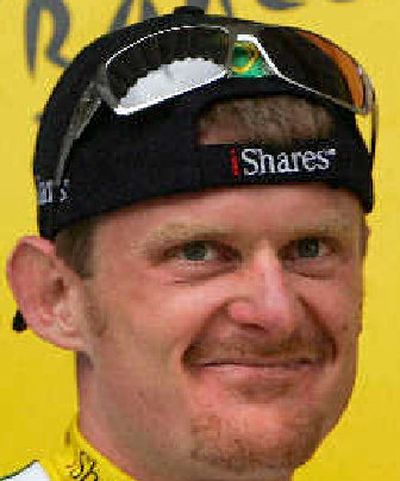
The 30-year-old, who rebelled against his pious Mennonite upbringing to start racing as a teen, grinned broadly as he became the fifth U.S. cyclist in the Tour’s long history to don the leader’s prized yellow jersey.
“A dream come true,” he said.
His performance offered a little clarity to the Tour. The race had been leaderless since a doping scandal knocked out several of the favorites before the start on July 1. Thanks to the Pyrenees, there are the beginnings of a hierarchy for the first time. Stage 11’s five arduous climbs over 128 miles, under the hot sun, mercilessly whittled down the field.
By the finish, at the Pla-de-Beret ski station above this Spanish town, just two riders had managed to cling to Landis: Menchov and fellow American Levi Leipheimer, looking to redeem what has been a horrible Tour for him.
Behind, still laboring up the gradient and on the short downhill to the line, were a host of riders whose names had been bandied around as possible contenders to fill the vacuum left by Armstrong’s retirement last year and by the withdrawal of German Jan Ullrich and Italian Ivan Basso – sent home because of allegations they were linked to a doping ring in Spain.
Although the gaps that Landis opened up aren’t as large as those that might come in the even harder Alps next week, they were still significant – if not decisive.
German Andreas Kloeden, runner-up to Armstrong at the 2004 Tour, finished 1 minute, 31 seconds behind. Portuguese rider Jose Azevedo dropped 4:10, as did Italian Gilberto Simoni. U.S. racer George Hincapie, another former teammate of Landis, put himself out of contention by trailing by a whopping 21:23. Basque rider Iban Mayo abandoned the race.
“It’s just not coming together for me. Very disappointed,” Hincapie said.
Landis took the race lead from Cyril Dessel, who held the yellow jersey for just one day. The unheralded Frenchman, who had been 4:45 ahead of Landis at the start of the stage, is 8 seconds back overall and can be expected to drop back further in the Alps.
“Everything will be decided in the last week in the Alps,” Menchov said.
The stage win was the Russian’s first in six Tours. He is third overall, 61 seconds behinds Landis. Australian Cadel Evans is fourth, 1:17 back. Leipheimer placed second in the finishing sprint behind Menchov and ahead of Landis, but still trails by 5:39 overall, in 13th place.
A question is whether Landis’ arthritic hip – the legacy of a training crash in 2003 – can carry him to victory in Paris on July 23. Even he said he’s not 100 percent sure – although it did not prevent him from finishing the last three Tours, the last one in ninth place after he switched from Armstrong’s team to his current squad, Phonak.
“Ordinarily with this condition, it’s a slow process and it isn’t a catastrophic failure in one day, so it’s unlikely at this point that it will be so much of a problem that it will affect the race,” Landis said. “But afterward I have to make a decision what to do and, at this point, I’m leaning toward a hip replacement because I am getting tried of dealing with it.”
No one has ridden the Tour with a hip made of titanium, steel or ceramic. Landis said he is “hopeful that a new one will work.” But in case it doesn’t allow him to continue professionally, he’s been savoring this year – winning the Tours of Georgia and California and the Paris-Nice stage race.
“I decided that I gotta force it no matter what, and I have to get a good season out of the one that I got,” he said.
Landis’ road to leading the Tour started by going behind his parents’ backs. Devout Mennonites, they weren’t thrilled when he started racing mountain bikes as a teen.
But for Landis, cycling provided a way out of a religion that he said didn’t suit him.
“I happened to be a little bit high-strung for that lifestyle,” he said.
Mennonites “tend to stay away from professional sports and being generally famous, I guess,” he added. He said his parents have “adjusted” to his career, but “for a while they were not so happy about it.”