
‘Simple man in complex world’ faces stark reality
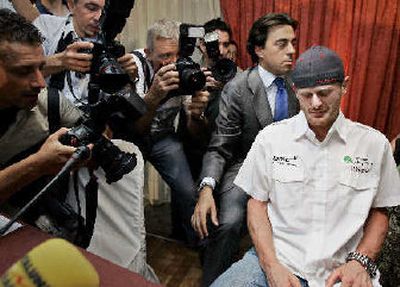
In all of the crazed and frantic hours since Floyd Landis’ testosterone-to-epitestosterone levels became the biggest story in sports, one thing has become abundantly clear: he’s no Lance Armstrong.
That’s not a dig at either one. Armstrong is a media master: sometimes intimidating, sometimes jocular, but always on message and always in charge of the situation.
Landis spent three years pulling Armstrong up steep mountain passes for the greater glory of U.S. Postal and American cycling. In all the miles he spent with the seven-time Tour de France champion, little if any of that Armstrong attitude rubbed off on the simple man from a simple family from Farmersville, Pennsylvania.
In a Friday phone-in news conference with high-powered reporters from USA TODAY, the New York Times and Chicago Tribune, Landis struggled with technical questions about his T-to-E ratio (he didn’t know what the A Sample test showed) and had difficulties explaining why he soft-pedaled a question in an earlier Madrid news conference about his previous doping history.
When asked why the public should believe him when other accused dopers made impassioned defenses, the most glib answer he could muster was, “Because I’m innocent.”
He is also much too open with reporters. He volunteered that he expected his B Sample to come back positive, which he said would happen because there was no reason to believe the ratios would change. He failed to explain that the real point was not the ratios, but what caused them to be what they were.
There is so little evidence available that it is impossible to say if Landis is guilty of doping. That will come out eventually, but 21st Century news cycles can’t wait that long. Anxious reporters find it hard to believe that Landis is not familiar with every aspect of sophisticated doping techniques or why he had no knowledge of latitudinal studies of his own T-to-E ratios.
People who know Landis say that’s just the way he has always been.
John Stamstad, one of the world’s greatest endurance cyclists and the captain of Landis’ first professional mountain bike team, says that with Floyd, what you see is what you get: a simple man in a very complex world.
“I got him on our team for a four-man endurance relay race, the 24 Hours of Canaan, in West Virginia in 1995,” Stamstad recalls. “Here was an 18-year-old Mennonite kid who had never consumed caffeine. He was as pure as the driven snow.”
When offered a can of Mountain Dew, young Landis told his teammates, “No way I’m touching that!”
Stamstad says Landis the young man is the same as Landis the embattled winner of the Tour de France.
“He had such an intense passion for riding a bike,” Stamstad says. “It was more than a desire, it was something that 99 percent of the world never experiences.”
Now Landis is experiencing a roller coaster ride that makes his Tour de France ride seem like a stroll down New Farmersville Road that passes by his family’s modest white-frame home.
There was a moment in Friday’s electronic media mosh pit when the real Floyd Landis fought back with the passion he demonstrates on the bike.
When asked about his mother Arlene, he shot back, “My mother is having to go through things she doesn’t deserve. She lives a simple life and now she’s overwhelmed by reporters and can’t begin to explain it.”
That’s a good description of Landis’ life right now.
At age 20, he turned his back on the simple life for the glitz and glory of a professional bike racer. A decade later, he’s discovering in a most painful way that reaching your goals in the real world often comes at a very high price.