
Science class helps kids learn to love learning
LOS ANGELES – Jazmani Busby has learned things in her nine years that no child should have to learn.
She has learned to drop to the floor at the sound of a gunshot. She has learned what an AK-47 looks like. She has learned that, all too often, the people around her die young.
Jazmani, a lifelong resident of the Nickerson Gardens housing project in Watts, doesn’t like to talk about these things. When she calls her best friend, Raquel Hernandez, the two fourth-graders are much more eager to talk about something else they’ve learned, something that makes them bubble with excitement.
Science.
“Science is my life,” Jazmani explained. “I eat, drink, breathe science. I just love science.”
She and Raquel attend 112th Street Elementary School, where Principal Brenda Manuel said, “The kids are just on fire about science.”
How did this happen? By conventional measures, 112th Street Elementary is a failing school. Its standardized test scores are among the lowest in California. Fewer than one-third of its students are considered proficient in math, fewer than one-fifth in English. Under the federal No Child Left Behind Act, the school could face sanctions if it fails to raise its test scores significantly this year.
Every student at 112th Street Elementary is poor enough to qualify for subsidized meals. Most of the students live in Nickerson Gardens, a housing project known for being violent and gang-infested. Many come from single-parent families or are in foster care. The school is 62 percent Hispanic and 38 percent black, and more than half of the students are learning English as a second language.
Yet teachers and parents say the school has become a place where good things are happening.
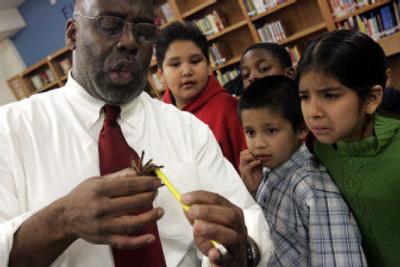
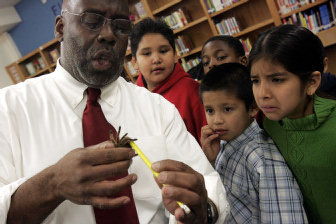
The children of 112th Street are on fire about science because a teacher named Stan White came into their lives last fall like a blowtorch – a large blowtorch with a wide smile, a shaved head, a crisp, no-nonsense manner and a deep-seated belief that these children are as capable of excelling as any children anywhere.
The children are eager to please White, in part because they like him, in part because they know the consequences of displeasing him will be swift and severe.
“Do you know the meaning of the digestive system?” he asked one girl who had been chatting with a neighbor.
“The meaning of the digestive system is….” She stopped and hung her head.
“Goodbye,” White said.
Knowing better than to argue, she quietly left to return to her regular class. White’s class is a special, pull-out event held in the school library, designed to supplement the school’s regular curriculum.
To be dismissed by Mr. White is a terrible fate. It means more than just missing out on science, although one suspects that would be punishment enough. (On this day, it meant missing out on the opportunity to hold a tarantula.) It means losing a chance to make The Team. For White’s real secret is that he has transformed science into a competitive sport.
Students compete for spots on the science team, and the team, in turn, competes with other schools – also coached by White – in “Jeopardy!”-style showdowns.
In the weeks leading up to one of White’s competitions, the students held conference calls at night to drill one another. They turned out on a Saturday when White agreed to lead an extra study session.
And teachers began to notice a spillover into their regular classes.
“This has elevated their esteem, elevated their desire to be part of something,” said Ed Allen, a fifth-grade teacher. And it has given him, as a teacher, a new disciplinary tool: If a student thinks misbehaving “will somehow affect his position on the science team, he’ll straighten up.”
There’s a greater desire to do well in all aspects of academics, he said.
Among inner-city children, White said, there’s an “initial lack of desire,” a feeling “that if they’re learning they’re somehow selling out.” Once students get past that, he finds that the children are not only as bright as their peers in affluent neighborhoods, but they’re tougher, more resilient. “Once they’re on, they can’t be beat,” he said.