
U.S., S. Korea begin talks
WASHINGTON – The United States and South Korea held their first round of talks Monday aimed at achieving a free trade agreement between the two nations before the end of the year.
An agreement with South Korea, America’s seventh-largest trading partner, would be the most economically significant such pact the United States has reached since it tore down barriers with Mexico and Canada more than a decade ago.
Assistant U.S. Trade Representative Wendy Cutler, who is heading the U.S. delegation, expressed optimism that the talks can be concluded before the end of the year even though the negotiators will have to deal with such tough issues as removing barriers to American farm products, pharmaceuticals and U.S. autos.
“I remain optimistic about our ability to conclude a high-quality, comprehensive agreement,” Cutler told reporters during a conference call Monday. “The political will is clearly there on both sides.”
Cutler praised Kim Jong-hoon, the head of the South Korean negotiating team, and said both countries had put in a great amount of preparatory work that should speed the effort.
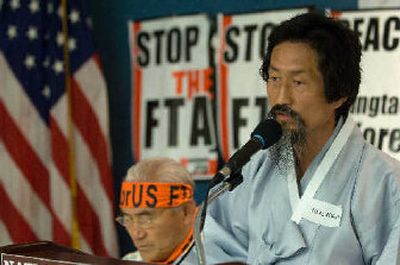
But as the two sides began negotiations at the U.S. Trade Office near the White House, the sounds of protesters could be plainly heard.
About 40 South Korean farmers and laborers and their American supporters have planned a weeklong series of demonstrations and rallies to coincide with the talks. South Korean rice farmers have engaged in a number of violent demonstrations in their own country to highlight their opposition.
For American consumers, a free trade agreement with South Korea would hold out the prospect of lower U.S. tariffs and thus cheaper prices on such South Korean products as cell phones and automobiles.