
Post Falls may replace City Hall
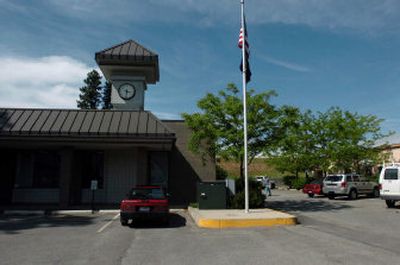

Post Falls is outgrowing its City Hall as fast as the city’s population is booming, and officials took another step Tuesday to replacing it with a roomier, modern building.
The design phase of the new City Hall building is now scheduled to be finished by late fall after City Council members unanimously approved about $681,000 in pre-construction contract costs Tuesday night.
Mechanical contractor McKinstry Co. will become a part of the design team working on the 36,000-square-foot project, analyzing the dollars it will take to construct an energy-efficient building and also seeking out potential bids for the maximum price of construction, said Gary Young, Post Falls community development director. McKinstry’s contract is a little more than $133,000 for pre-construction costs.
The company will also play an integral part in designing the overall City Hall campus, which includes the building itself, and redesign of the area where the current City Hall sits.
The council also added another $85,000 to the contract of architectural firm G.D. Longwell to incorporate analysis of Leadership in Energy and Environmental Design, or LEED, certification, which is the standard for “green” buildings. G.D. Longwell’s contract stipulates that the firm receives 9 percent of the overall construction cost for its fees, which are estimated at $585,000 for a $6.5 million project.
Construction originally was set to begin as early as this spring, but the city decided to search for a contractor like McKinstry to develop an “energy modeling” plan, Young said. He said it took several months for that process to play out.
But some City Council members expressed concern Tuesday night that LEED certification was merely cosmetic and would cost too much.
Council member Todd Tondee equated the certification to an impressive emblem on a car hood, which was unnecessary as long as the vehicle got good gas mileage.
“(LEED certification) means nothing to me,” Tondee said.
This sort of step in design is also pertinent to the city’s goal of building an energy-efficient building, Young said.
Mayor Clay Larkin said before the council meeting that he is concerned with an energy-efficient building because of the initial costs of the project.
“It’s a big issue. We want it to be environmentally friendly, efficient and affordable, which is why I’m hesitant to say I’m happy with the contract,” Larkin said. “We have to listen to the taxpayers that are going to pay for this.”
Larkin said this sort of contract is a Catch-22 because the city could pay McKinstry hundreds of thousands of dollars to come back with a plan the city might not be able to afford.
“The numbers I’m hearing – and I don’t want to discuss those numbers – but they’re right on the edge of being affordable,” he said.
Young said the point of bringing in the contractor is that money would be saved over the lifespan of the building based on their analysis.
No matter the price of the proposed design, Larkin said the city had “control of the checkbook,” so if the project was too expensive it would not go forward. If that were to happen, McKinstry’s contract stipulates that the firm will be reimbursed the $133,000 for the initial energy modeling phase. If a plan is approved, the firm’s fees will be included in the final construction costs.
Still, no city official interviewed believes a new City Hall is unnecessary.
Larkin said though some upgrades were completed in 1998, he could show people cracks in the walls and other construction maladies in need of repair.
“We knew then it wasn’t going to last 20 years,” Larkin said. “It isn’t that we want something, it’s something that we truly need.”