
Fashion goals
NEW YORK – World Cup team uniforms – “kits” as they’re called in most of the soccer-loving world – are not just a sideline topic. They are the face of a nation, and perhaps even a tactical tool as well.
Carefully designed for the quadrennial event by huge athleticwear companies like Nike, Adidas and Puma, the soccer players’ sleek jerseys have been easily adopted by fans off the field as both fashion and patriotic statements. On the field, some say, the uniforms’ fabric, design and color can give a team a subtle edge.
So who’s got a winning design? Check out the third-ranked Netherlands, says Leatrice Eiseman, director of the Pantone Color Institute, a color research and information center. The Dutch jerseys prominently feature both orange and a touch of blue, a good juxtaposition of cool and warm, Eiseman says. The blue radiates confidence and consistency, while there’s a fire to orange.
“You can’t ignore this team,” Eiseman says.
The Dutch are playing in outfits designed by Nike, which created jerseys for eight countries. The “home” orange jersey was inspired by the 1959 national team design, and it gets fashion kudos for being the only one in the tournament with a trend-right polo collar. The design for the white “away” jerseys with diagonal orange and blue stripes dates back to 1905, when the first national team shirt debuted. (All teams have two uniform designs.)
Nike began the World Cup project three years ago, sending researchers and designers to each country to soak up the culture, Peter Hudson, the brand’s global creative director, explains. “Giving each team a kit based on their colors and badge was no longer acceptable. To be truly relevant and connect with each of the teams, we had to deliver something individual for each team,” says Hudson, who has split allegiances between his native England – not a Nike team – and Brazil, for which he personally designed the solid yellow and solid blue kits.
“It was about finding a balance in the jerseys. How do you pay reverence and respect to the teams themselves? We were not as interested in overbranding.”
Nike’s Sphere Dry fabric is used in all the jerseys. It’s supposed to keep athletes drier and cooler by wicking away moisture. There also are nodes on the underside of the jersey that keep the shirt from clinging.
But even with just a single subtle Nike swoosh on the jersey and one on the shorts, this World Cup surely is lining the pockets of sports gear companies: There’s been a 300 percent increase in sales of the Nike’s World Cup wear since the 2002 tournament, with 2.4 million kits sold globally. The best-sellers in the United States are Mexico, U.S. and Brazil.
History, more so than psychology, played a role in several designs: The Dutch home jersey has a shield behind the team’s crest in a baby blue color that was used in ‘59. And for the Brazilian home jersey, Nike returned to a softer, sun-kissed and traditional Brazilian yellow instead of the citrus shade that was featured on the jerseys for the 2002 World Cup.
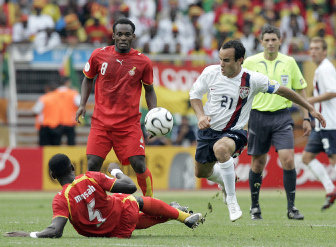
The Americans wanted a jersey that was bold and iconic, which isn’t dissimilar to what the team always asks for, Hudson says. But there was a collective decision made to make it cleaner and more sophisticated than in the past. The stripes in the American jerseys and socks pay homage to the uniforms the U.S. wore in its surprise upset of England in the 1950 World Cup. Plus, the shape of the shirt is more fitted, which gives it a different language on the field, he adds. “It can be a performance advantage, too. There’s less chance for an opponent to grab you.”
Pantone’s Eiseman, whose most recent book is “More Alive With Color” (Capital), runs down the message behind the colors seen on most jerseys:
“Red is the quintessential power color – see the second-ranked Czech Republic home jerseys. “It signals we’re powerful, we’re here, you’re not going to ignore us,” she says.
“Blue is generally a calming color but it’s also seen as dependable and consistent. Eiseman notes that so many World Cup teams are wearing blue: Ecuador, Sweden, Paraguay, Italy and France, to name a few.
“Green can be energetic. Those bright jerseys of the Mexico and Ivory Coast are vibrant and alive.
“White, as seen on jerseys such as the South Koreans’ away uniform, is always the sign of purity and its intentions are always good. It’s straightforward, clean, Eiseman says.
“Yellow is active and is often associated with power because many cultures relate it to the sun – see first-ranked Brazil’s home kit.
“Orange is the offspring of red and yellow, and the influence of both colors comes through. It’s assertive and active like red but it’s also perceived as friendlier and more approachable.
While Eiseman favors the blue-and-orange uniform combination, two British anthropologists at the University of Durham earlier this year conducted a study showing red to be the power color. Looking at four individual combat events at the 2004 Olympic Games, athletes wearing red gear won more often in 16 of 21 rounds of competition in all four events.
The researchers also did a preliminary analysis of the Euro 2004 international soccer tournament and found that five teams scored more goals and won more often when they wore shirts that were predominantly red, as opposed to blue or white jerseys.
Red may subconsciously intimidate opponents in athletic contests, especially when the athletes are equal in skill and strength, Russell A. Hill and Robert A. Barton suggested in their report.
Contacted by the AP for this story, Barton says he can’t make scientific predictions because there are so many other factors, including world rankings and the frequency a team wears its home or away jersey. That said, there’s a completely unscientific office pool going on and he and Hill think fifth-ranked Spain (with one being a yellow-striped red home jersey) is “our tip to win.”
So does this forebode a sea of fashion fans in either red or orange clothes once the World Cup is done?
Probably not, since soccer enthusiasts stick to team colors, and style watchers know, of course, that this is the summer of white and the upcoming fall is dominated by a neutral palette.
What will likely carry over beyond the soccer tournament? Nylon shorts replacing tighter knit ones at the gym and the nylon pullover pushing aside the hoodie, predicts Tom Julian, senior vice president of trends at ad agency McCann Erickson.
“It fits in with the sleeker, younger wardrobe of today,” says Julian.