
‘Trek’ technology
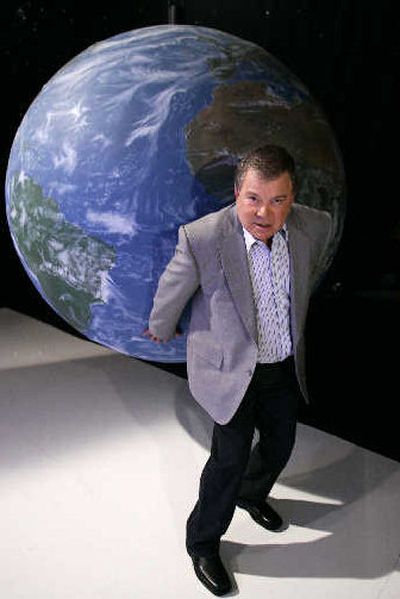

Capt. James Kirk’s alter-ego, William Shatner, really did shake up the cosmos.
The irreverent documentary “How William Shatner Changed the World” features the actor examining the ways “Star Trek” technology inspired such real-life inventions as flip phones resembling the show’s communicators and medical equipment reminiscent of the starship Enterprise’s sick bay.
Premiering Sunday on the History Channel, the show kicks off the network’s “Out of This World” week, featuring explorations of comets, meteors and UFOs.
Based on Shatner’s book “I’m Working on That,” in which he explored the connections between “Star Trek” technology and real science, “How William Shatner Changed the World” takes the tongue-in-cheek approach the actor often applies to what he considers the over-serious fandom of the TV shows and movies.
It examines how Gene Roddenberry’s sci-fi series helped energize scientific explorers who created gadgets we could only dream about when it premiered in the 1960s.
Shatner chats up researchers who were fascinated by the tricorders, communicators, medical scanners and other devices Roddenberry and his collaborators put in the hands of the 23rd-century “Star Trek” gang.
Viewing this brave new world of technology – then staring around a real world where clunky computers filled entire rooms and talking long-distance meant tethering yourself to a rotary phone – these impressionable young minds set out to make what they saw on “Star Trek” a reality.
“Scientific advances mostly are incremental,” Shatner says. “If enough time goes by, a decade goes by, suddenly, that increment, you take year one to year 10, looks like a giant leap. So here we are 30, 40 years after ‘Star Trek,’ and it looks like it was extraordinary, the advances we’ve made.”
While we’re not yet having our scrambled molecules beamed from place to place, the documentary reviews “Trek”-like technology that has come into being, including laser scalpels and other noninvasive medical equipment.
There also are interviews with researchers who were inspired by “Star Trek” to miniaturize computers, study time travel and search for alien life.
Other shows in the History Channel’s “Out of This World” week include “Comets: Prophets of Doom,” “Meteors: Fire in the Sky” and the UFO documentary “An Alien History of Planet Earth.”
The week is more pop-culture oriented than the programs about wars and politics that typical History Channel viewers tune in for.
“We don’t know how they’ll take to it, but it’s not that far out. You do learn a lot,” said Charlie Maday, senior vice president of programming at the History Channel.
“It will be a fun week. It’s sort of like William Shatner’s personality. He’s informative, and he’s fun to watch.”
During the “Star Trek” documentary, Shatner struts, blusters and soliloquizes about the impact of the show, hamming it up as much as he ever did as the melodramatic Kirk.
He balances respect and ridicule for “Star Trek,” which he famously mocked in a “Saturday Night Live” skit in the 1980s, where he told costumed fans at a “Trek” convention to “get a life.”
“I’ve always had sort of an ironic view of life,” says the 75-year-old Shatner. “My belief system is that when this is over, it’s over. That you don’t look down from heaven and wait for your loved ones to join you.
“There may be some soul activity, but I’m not sure about that. But what I am sure about is that your molecules continue and in due time become something else. That’s science.
“And that works for me. So that if this is it, you better take it at its right proportion. That there are serious things, but most things are temporal and ephemeral, and you should cultivate that attitude. … So I try not to take too many things seriously, and if I find myself caught up in the seriousness of the moment, within a period of time, I’m able to cajole myself out of it.”
Shatner, more recently an Emmy-winner as an egotistical attorney on “Boston Legal,” also stars in a hybrid musical-reality show about his life called “William Shatner in Concert,” airing this month on TV Land. While best known as the fearless Capt. Kirk, Shatner does not share the rosy view of technology and humanity’s future that motivated “Star Trek” creator Roddenberry.
“Technology has brought us to this point of self-destruction,” he says. “It’s the dichotomy of our curiosity and greed, which are hardwired – greed, because we had to survive because we were always hungry, so we had to gather things, and curiosity, which brought us out of the trees.
“In small amounts, they’re the difference between us and the rest of the animal world. In large amounts, they’re causing the destruction of everything. And I think technology has put us in a position of destroying the planet as we know it, and us along with it.
“I’m very pessimistic about the future of mankind based on all the things that are going on now and our lack of will to correct it.”