
Banks retool to meet needs of Hispanics
KANSAS CITY, Kan. — One of Maria Carrillo’s clients said thieves jumped him on payday because they knew he’d leave the check-cashing business with his pockets full of bills. How was he to know he could open a bank account in this country, Carrillo said, if he was still struggling to read in Spanish?
Carrillo, a financial consultant whose office windows look onto a ward of this city where taquerias have replaced steel plants, knew he was just the kind of client banks want.
As the housing market slows, lenders have come to see the country’s new Latino immigrants as a market with a great upside. By 2010, the disposable income of Hispanics will exceed $1.08 trillion, or 9.2 percent of total purchasing power nationwide, according to the Selig Center for Economic Growth at the University of Georgia.
Even as Congress debates their legal status, banks are tailoring their products to meet the country’s newest residents where they work and live, installing ATMs in meatpacking plants and creating special mortgage packages that don’t require the traditional documentation.
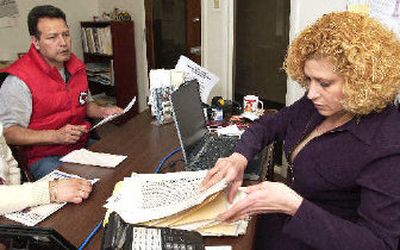
“If I buy a home here, I want to be 100 percent sure of what I’m buying,” said Victor Cruz, a native of Toluca, Mexico, as he met with Carrillo at the Kansas City-based nonprofit El Centro, Inc., an outreach group that helps immigrants with everything from ESL classes to money matters. “Otherwise, you end up feeling like a rabbit, surrounded by foxes lying in wait.”
After experiencing decades of financial crises and currency devaluations in Latin America, first-generation immigrants often prefer to carry cash than to deposit their money in the bank. Reports of predatory lending and payday muggings in the Hispanic community have prompted officials at Federal Reserve Banks across the country to encourage lenders to develop alternative means to bring Latino families into the banking system.
One-third of U.S.-born Hispanic residents and over half of all Mexican immigrants lack bank accounts, according to 2000 figures from the U.S. Census Bureau. But there’s no single formula that meets the diverse needs of the Latino market.
“The number one mistake that banks make is to translate their brochures. They think having their information on a pamphlet in Spanish will produce magical numbers for them,” said Laura Castro de Cortes, a consultant at Latino Banking Solutions, based in Omaha, Neb. “For second-generation Latinos, we’re gonna react like the rest of the market and say ‘OK, who has the best price?’ That’s totally different from marketing for the new arrivals, whose biggest problem is that they walk around with rolls of cash.”
Many undocumented Latino immigrants shy away from mainstream lenders for fear that giving over personal identification could result in deportation. The USA Patriot Act requires banks to ask customers opening an account for their name, date of birth, address and a taxpayer identification number.
Before Cruz can get a home loan, for instance, he’ll need to provide Carrillo with two years of tax records and employment records, his taxpayer ID number and three credit reference letters. Carrillo isn’t brokering a loan for him, she’s just helping him find the deal that fits best with his income level.
El Centro is one of few groups to offer that kind of detailed financial education in Spanish in the Midwest. But in recent years, the number of products available to the undocumented has mushroomed.
In Illinois, non-citizens can now qualify for state-administered mortgage loans by providing a government-issued alternative to the Social Security number. In Kansas City, Mo., a family-owned bank with just eight branches started selling stored-value cards, a “starter” product that’s not a bank account, but gets clients ready to open one.
As baby boomers age and their savings leave the financial system, banks see the Latino population’s relative youth as a plus. By 2010, a study by the Joint Center for Housing Studies of Harvard University shows Latinos will account for nearly one-third of the homebuying pool.