
For those about to shock
Perhaps you’ve seen the scores. In 2000, Iowa 77, Albany 76. In 2001, New York 99, Carolina 68. Last week, Dallas 87, Orlando 62.
These aren’t college, CBA or NBA scores. These are Arena Football League outcomes. Fairly common ones, at that.
There is no Cover 2 defense in arena football. No stunting, no punting, no zone blitzes, no milking the clock with 3 minutes left to hang on to a four-point lead. There are few running plays and fewer defensive stops. There are a ton of passes, touchdowns and defensive coordinators yanking their hair out.
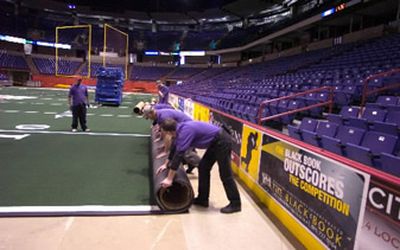
It’s 8-vs.-8, with many of those eight playing both ways on a field measuring 50 yards long, 85 feet wide. Players get knocked into the front row of seats, overthrown passes sail into the crowd (where fans keep the football as a souvenir) and after the final horn those same players sign autographs on the field.
The madness comes here this week as the expansion Spokane Shock debuts in arenafootball2 – the younger brother of the AFL – when Stockton visits the Arena at 7 p.m. Thursday.
“For the fans, it’s going to be crazy because they haven’t seen some of this stuff before,” Spokane coach Chris Siegfried said. “The atmosphere is one of the beautiful things about arena football. Everybody is right on top of the action. One of the things I personally enjoy is the fact that people are right there and can hear what the players are saying. Fans will never be closer to a game than they will in arena football.”
The rules are purposely set up to encourage scoring fests. New York, with former Washington State Cougar quarterback Aaron Garcia, averages seven passes for every rushing play. The AFL’s leading rusher averages 15.5 yards per game. Dallas quarterback Clint Dolezel tossed 11 touchdown passes in a game last Sunday.
“It’s all about the quarterback,” Siegfried said.
And it’s about having three linemen and a fullback providing protection so three receivers can go to work against three defensive backs. Another offensive bonus – one receiver can be in motion and often uses a 15-yard running start so he hits the line of scrimmage at top speed.
“Some people think being a defensive coordinator in arena football is career suicide,” Shock D.C. Troy Biladeau laughed. “All the rules are made for the offense and trying to get fans in the stands and high-scoring games. That’s what they want, but you’d be surprised by how many teams that win the Arena Cup or advance to the playoffs have pretty good defenses.”
Biladeau said defensive scheming is pretty limited, but he tries to keep the opposing quarterback guessing.
“If we run a zone, there’s going to be a hole somewhere because you don’t have the extra safety,” Biladeau said. “We play a lot of man and we’ll mix in some zone that we try to make look like man.”
One linebacker, called the Mac, is allowed to blitz, but only through the gap on either side of the center. Another linebacker, the Jack, must remain in an imaginary box near the line of scrimmage until the pass is thrown, the fullback goes out on a pass pattern or the quarterback exits the pocket.
Biladeau said the defense’s main priority is generating a pass rush. That helps minimize inherent disadvantages faced by the secondary. The top defensive back usually defends the receiver in motion. With the reduced number of players on the field, tackling is critical because missed tackles often lead to touchdowns.
“It’s like fastbreak football,” said Shock receiver/defensive back Billy Newman, a WSU grad. “It’s kind of a cross between basketball and football and it’s just go, go, go.”
Biladeau said his goal is to hold teams to 35-40 points, but knows anything from zero to 100 is possible in arena ball.
“I’ve actually been in a shutout – Quad City over Peoria, 41-0,” he said. “I was an assistant coach for Quad City, thankfully.”
Siegfried makes a simple request of his defensive coordinator.
“We want to get one stop a half,” he said. “If we do that, really then it’s on me because I coach the offense. One stop a half and we should be winning games.”
And fans.
“They’re going to be fans for life after that first game,” Siegfried said. “They’re going to be blown away by how exciting it is. Once you go to a game you’re hooked – as long as we put a good product on the field.”