
High prospects for fun at Post Falls show
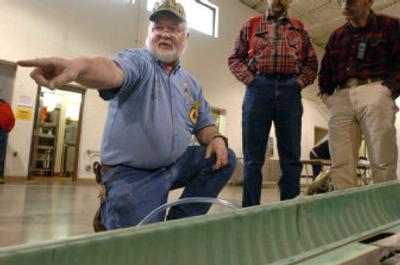
Gold is in Bob Lowe’s blood.
Not strictly speaking, of course, because that would be dangerous. But gold runs deep in his family heritage, and even to this day, Lowe likes gold very, very much.
Lowe’s grandfather prospected across the Northwest, sifting through the black silt of riverbeds for those precious specks. This weekend, Lowe said, his mother is wandering an arid Southwestern desert, searching for precious metal treasures.
Today, the 55-year-old founder of the Northwest Gold Prospectors Association continues to prospect, but most of his income is from the sale of mining equipment.
“My grandfather said the only way you’re going to make money is to mine the miners,” Lowe said, laughing.
The curious thing about the modern prospectors at the seventh annual Gold and Treasure Show in Post Falls is that they all say they aren’t trying to get rich. Most of the prospectors at the show – which continues today – say they enjoy exploring riverbeds and spending time with family and friends.
Still, it doesn’t hurt that the price of gold has more than doubled in the past five years, topping $550 per ounce.
“There’s always the chance that the next shovelful is going to pull up the big one,” Lowe said.
Gold prospecting – long dominated by crotchety old men with suspenders and poor dental hygiene – has evolved into a healthy, family activity, Lowe said.
“It’s outdoors, it’s good exercise, and it’s very social and family-oriented,” said Lowe, who owns a gold-prospecting park near Pritchard, Idaho. “It’s not just the old recluse anymore.”
Healthy or not, gold prospecting retains an almost mystic hold on some prospectors.
At Saturday’s show, a dozen people hovered near a plastic tub where – for $1 – you could pan for gold.
Nearby, Jerry Dillon, a 72-year-old hobby prospector from Wenatchee picked up two brass rods and demonstrated how to “dowse” for gold. As he held the rods loosely in his hands, they slowly spun toward the vial of gold.
“You just start thinking positive, and it’ll hone right in on that,” Dillon said. “Nobody can really come up with a sound reason for it. It has to do with the electrolysis in your body.”
Like many collectors, Dillon keeps his gold flakes in small vials of water, which makes the flakes look bigger.
“When you find it, you’re the first person to ever see it,” Dillon said, holding a tiny vial up to the light.
A few feet away, Steve Burris stood among a group of prospectors. Burris, 67, gained renown two years ago when he found a 2.5-pound gold nugget while searching in a remote riverbed in Alaska.
“It was just lying on the dirt, right on top,” Burris said. “I really couldn’t believe it. I looked down and thought, ‘Is that gold?’ “
Today, the nugget, which is worth about $30,000, resides in a safety-deposit box at a bank. Burris said he doesn’t plan to sell it because of the taxes he’d have to pay.
That is, he said, “Unless the price is right.”