
Bush blames Saddam for violence in Iraq

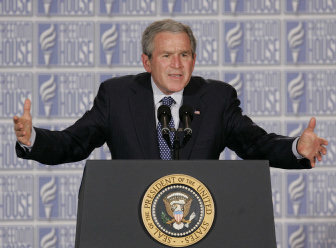
WASHINGTON – President Bush on Wednesday blamed Saddam Hussein for the bloody carnage on Iraq’s streets.
“Much of the animosity and violence we now see is the legacy of Saddam Hussein,” Bush said in a Washington speech.
Saddam “was a tyrant who exacerbated sectarian divisions to keep himself in power,” the president said, and “the toxic atmosphere in today’s Iraq bears witness to his terrible handiwork.”
The president also expressed impatience with the Iraqi factions who have been struggling for months to form a unity government, which could allow for U.S. troop reductions.
“I also want the Iraqi people to hear – it’s about time you get a unity government going,” Bush said. “In other words, Americans understand you’re newcomers to the political arena, but pretty soon it’s time to shut her down and get governing.”
In his latest effort shore up failing support for the war and his own approval ratings, Bush exhibited a new willingness to admit that Americans had “legitimate questions” on the conduct of the war that has marked his recent appearances before audiences that were not screened by White House aides.
Bush appeared at ease and bantered with the audience in a lively question-and-answer session, but Democrats were not impressed.
“The president can give all the speeches he wants, but nothing will change the fact that his Iraq policy is wrong,” said Senate Minority Leader Harry Reid, D-Nev.
“Two weeks ago, he told the American people that Iraqis would control their country by the end of the year,” Reid said. “But last week, he told us our troops would be there until at least 2009.”
Anticipating the criticism, Bush said, “The irony is that the enemy seems to have a much clearer sense of what’s at stake (in Iraq) than some of the politicians here in Washington, D.C.”