
A coming of age
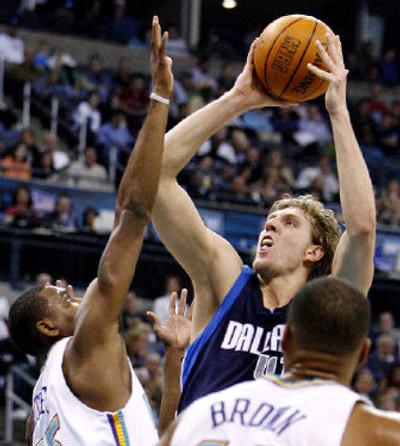
DALLAS – Dirk Nowitzki’s basketball “toolbox” is almost full. Once a lanky teenager with little more than a natural jump shot, Nowitzki’s raw potential made him a lottery pick at age 20. Even when he became an All-Star at 23, the 7-footer still had plenty of room for improvement.
Defense, especially. Rebounding, too. And for a big guy, he sure had a lousy post-up game.
Now, a month shy of turning 28, Nowitzki has put it all together.
He’s coming off his best regular season, topping his performance of the previous year, when he was third in the MVP voting. This one was better because he led the Dallas Mavericks to 60 wins – matching the franchise record he helped set three years before.
While Kobe Bryant, LeBron James and others have been dazzling in the playoffs, Nowitzki’s been brutally efficient.
He helped Dallas build insurmountable halftime leads in the first two games against the Memphis Grizzlies. Then, with Game 3 seemingly lost, he grabbed a loose ball, smartly maneuvered behind the 3-point line and swished a shot that forced overtime and essentially wrapped up the series.
Nowitzki was deficient in many areas early in his career because he didn’t grow up around the game the way most NBA players do.
Growing up in Germany, there were no all-star basketball camps. Not even a high school team. All he had was a coach-mentor-guru who’d played in the Olympics and who knew the quickest way to the NBA was the novelty of someone really big who could shoot from really far.
Even after he established himself in the pros, Nowitzki went home every summer to work on rounding out his game. “Filling the toolbox” is what the molder of his career, Holger Geschwindner, calls it.
Geschwindner visits several times per season, and was in town at the start of the playoffs. Meanwhile, Nowitzki has been a regular at the team’s practice court, refining the shot that’s produced at least 20 points in 31 straight games and an average of 31.3 in the playoffs.
Mavericks coach Avery Johnson sometimes threatens fines when he fears Nowitzki is overworking himself. He relented this week, even sending a coach to the gym for nighttime workouts.
“I love working on my game, love improving,” Nowitzki said this week, sweat dripping from a thick, shaggy beard. “I just love the sport so much, I think there’s always stuff to work on, get better.
“Ultimately, our goal, my goal, is to take this team to a championship level. The first round means nothing if we lose in the second round. I’m just trying to stay ready and do more of the same in the second round.”
Nowitzki’s rising career hit some turning points over the last year.
First, his best friend on and off the court, Steve Nash, switched teams. That thrust Nowitzki into the front-and-center role of team spokesman and leader, things his talent had demanded long before but his personality wasn’t necessarily ready to handle.
Then, six weeks before the 2005 playoffs, his leadership was put to the test with the retirement of Don Nelson, the only NBA coach he’d had.
General manager Donnie Nelson and team owner Mark Cuban already were transforming the team from an ill-fated scheme featuring five shooters on the floor to a system based on the more traditional championship formula of defense first. The plan hit full speed with Johnson replacing Nellie.
Nowitzki had to go along for it to work. The coach of the year trophy in Johnson’s office proves he did.
This season, Nowitzki averaged a career-best 26.6 points despite the Mavs scoring their fewest points since his rookie year. Part of the increase came from his confidence in the low post. Johnson said that on a 10-point scale, Nowitzki has gone from about three to 6 1/2.
“When you get older, you get more experienced,” Nowitzki said. “I’m not a great post-up player, but I’m more comfortable.”
He, like the whole team, has improved dramatically on defense. The Mavericks allowed the fewest points per game in franchise history.
“Nowitzki used to be a guy you’d go at every time down the floor,” Rockets coach Jeff Van Gundy said. “Now he’s a good defender. He’s good at stripping the ball on the way up and he’s a great rebounder. People keep saying he’s soft, but what does that mean? It doesn’t come from the guys he plays against.”
With his buddy Nash reportedly to be named MVP again, Nowitzki probably will finish second or third.
Perhaps he’ll eventually earn that individual award, but the focus now is whether his toolbox is complete enough to claim the NBA’s most important piece of hardware.
“Dirk,” teammate Jason Terry said, “is definitely going to be one of the legends in this league when all is said and done.”