
Disease in fish puts focus on dam
CLARK FORK, Idaho — Avista Utilities has a fish problem.
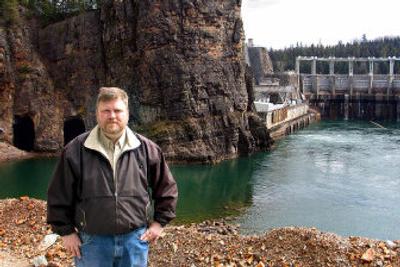
The large Cabinet Gorge Dam on the Clark Fork River is suspected of giving fish gas-bubble disease, an affliction akin to the nemesis of deep-water divers — the bends.
The dam plugs a narrow canyon on the Montana-Idaho border, generating enough electricity to power 170,000 homes of Avista customers in North Idaho and Spokane.
But the powerhouse at the dam can only handle about a third of the water roaring down the river once warm weather begins melting mountain snowpack. During this peak runoff the rest spills over the dam and plunges into a deep pool, infusing the water with excess nitrogen and oxygen.
The result: native bull trout, mountain whitefish and cutthroat trout can be killed in the last eight-mile stretch of river below the dam and throughout much of Lake Pend Oreille.
It’s the same for popular introduced species such as rainbow and brown trout, and kokanee salmon.
“Cabinet Gorge Dam is built just right to be wrong,” said Ned Horner, Idaho Fish and Game Department regional fisheries manager.
Fish swimming at deeper levels of the river and lake absorb the dissolved gases in the bloodstream. When these fish swim nearer the surface, the gas forms bubbles in fine tissues such as the eyes, skin and gills and can block the flow of blood.
State and federal standards govern the amount of dissolved gas that can be present in fish. And in the Clark Fork and even as far as the long bridge crossing Lake Pend Oreille at Sandpoint, fish have been found with dissolved gas levels exceeding the limit.
By most accounts, Avista is trying to solve its dam/fish quandary as quickly as possible. The company is exploring the idea of reopening two tunnels dug in the early 1950s to divert the river while workers built the dam.
The upstream tunnel entrances are now sealed and rest 100 feet below the surface of the reservoir behind the dam. The downstream tunnel exits are visible near the base of the canyon wall.
If Avista must reopen the twin tunnels – each measuring about 40 feet in diameter – it will spend about $38 million opening the first by the year 2010.
The second tunnel would be reopened at a cost of about $26 million some 10 years later if the first tunnel project was deemed a success, the company disclosed to shareholders and financial regulators in U.S. Securities & Exchange Commission filings released last month.
The company expects that any money spent on such an ambitious project would be recouped from ratepayers.
To ensure the idea isn’t folly, Avista hired Seattle engineering firm ENSR to build a 1/50 scale model of the dam, the tunnels and its water flow. Some modeling results have been encouraging. Others have not.
Tim Swant, Avista’s Clark Fork license manager, put the odds of reopening the first tunnel as even.
“We don’t have a lot of other options,” he said.
A fish biologist by training, Swant said he is working to ensure sound science and engineering guide the final decision.
John Scott, a member of Trout Unlimited who sits on a committee studying the issue, said no one wants a temporary solution that could harm the dam.
Scott, though, has fished the river for years and said something needs to be done to ensure healthy fish.
Yet $64 million is a lot of money to spend on fish protection and some people aren’t convinced that reinforcing and then reopening the old tunnels is the best use of such cash.
Avista also operates the Noxon Rapids Dam upriver from Cabinet Gorge under a widely acclaimed operating agreement noted for its collaboration with river users and its emphasis on protecting and restoring bull trout habitat.
These projects are credited with helping fish and engendering good will with local communities, which benefit from Avista spending on amenities such as campgrounds, city parks, boat ramps and land protections where public access and hunting are still allowed.
Spending millions to solve a problem that may not be fully understood is more difficult.
One scenario holds that the water is already loaded with dissolved gas from other dams upriver, according to Avista. In that case, exclusively blaming the Cabinet Gorge Dam may not be accurate.
Furthermore, there’s little evidence of big fish kills in the river and lake, even during periods of sustained high runoff such as in the spring and summer of 1997.
The Clark Fork is the key waterway of Western Montana. Beginning along the Continental Divide outside of Butte, the river gathers flow as it parallels Interstate 90 on the way to Missoula. There, it collects the Blackfoot River, made famous by Norman Maclean is his book “A River Runs Through It.” Once outside Missoula, the Clark Fork gathers the Bitterroot River and eventually absorbs the rivers that drain Hungry Horse Reservoir and Flathead Lake.
Horner acknowledged there’s concern that forcing Avista to spend $64 million to run water around the dam and through old diversion tunnels, instead of over it, may not fix the fish problem and may even affect the integrity of the canyon walls that anchor the dam.
Water, he said, is a powerful force. He recalls the ground shaking during the peak runoff nine years ago: “It was an awesome thing.”
Another concern is that reopening the tunnels won’t make a difference in a river that already has a low fish count when compared with other rivers. The Clark Fork is polluted from historic mining and smelting operations. Though tailings are mostly captured behind dams farther upstream, the river’s recent history is not one of a thriving fishery.
Swant said a decision on the tunnels could be made this year.
“Nothing is getting easier,” he said. “We’re doing our best.”