
Barbaro surgery successful
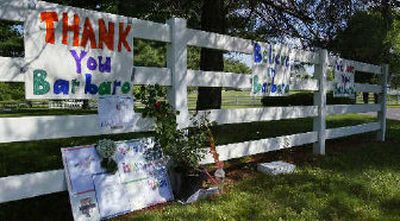
KENNETT SQUARE, Pa. – Barbaro underwent more than five hours of surgery Sunday to repair rear leg bones he’d broken in the Preakness, calmly awoke from anesthesia and “practically jogged back to his stall” for something to eat.
His survival, however, is still 50-50.
Despite the huge first step on the road to recovery, Dr. Dean Richardson said the Kentucky Derby winner’s fate still came down to “a coin toss.”
“Right now he’s very happy,” Richardson said after the surgery at the University of Pennsylvania’s New Bolton Center for Large Animals. “He’s eating, he’s doing very good. But I’ve been doing this too long to know that day one is not the end of things.”
The strapping 3-year-old colt sustained “life-threatening injuries” Saturday when he broke bones above and below his right rear ankle at the start of the Preakness Stakes. His surgery began around 1 p.m. Sunday, and it wasn’t until some eight hours later that Richardson and trainer Michael Matz emerged to announce that all had gone well.
“From the last time I saw him to now was a big relief,” said a visibly fatigued Matz. “It’s just an amazing thing to see him walk in like that.
“I feel much more comfortable now. I feel at least he has a chance.”
Barbaro sustained a broken cannon bone above the ankle, a broken sesamoid bone behind the ankle and a broken long pastern bone below the ankle. The fetlock joint – the ankle – was dislocated.
Richardson said the pastern bone was shattered in “20-plus pieces.”
The bones were put in place to fuse the joint by inserting a plate and 23 screws to repair damage so severe that most horses would not be able to survive it.
When he came out of surgery, Barbaro was lifted by sling and placed on a raft in a pool so he could calmly awake from the anesthetic. Richardson said the horse “practically jogged back to his stall” and was wearing a cast from just below the hock to the hoof.
Richardson again stressed that surgery was just the first step on a long road to recovery.
“Getting the horse up is a big step, but it is not the last step by any means,” he said. “Horses with this type of injury are very, very susceptible to lots of other problems, including infection at the site.”
Horses are often euthanized after serious leg injuries because circulation problems and deadly disease can arise if they are unable to distribute weight on all fours.
Richardson said he expects Barbaro to remain at the center for several weeks, but “it wouldn’t surprise me if he’s here much longer than that.”
The New Bolton Center is widely considered the top hospital for horses in the mid-Atlantic region.