
Multimillion-dollar storyteller
James Patterson’s life was an accident – a clashing of indecisiveness, a lost first love and an idea that there were rules for ordinary folks like him.
But at 59, there’s nothing ordinary about the multimillionaire author.
Patterson has published 35 books, 18 of which hit No. 1 on The New York Times list of best sellers. He’s sold 100 million copies, grossing $1 billion in sales.
His thrillers “Kiss the Girls” and “Along Came a Spider” have been made into movies starring Morgan Freeman as criminal profiler Alex Cross, and more Hollywood deals are in the works.
The former chairman of J. Walter Thompson advertising firm, Patterson produces up to five books a year: mysteries, thrillers, fantasies, love stories and children’s themes. He made $40 million last year.
Still, despite the fame and fortune, he sees himself as “just a guy that tells stories,” his work as “scribbling.”
“My books are good of their kind,” Patterson says matter-of-factly as he sits in his pale yellow multimillion-dollar waterside mansion in swanky Palm Beach, Fla., with two Mercedes-Benzes parked in the driveway.
Patterson’s latest book, “Beach Road,” which he wrote with journalist Peter de Jonge, debuted at No. 1 on the Times list last week. Another book, “Judge & Jury,” is due out July 31 – his third for the year so far.
A few years ago, Patterson began using collaborators to boost his output.
“I do have a big imagination,” he says, the slit of his left eye closing to a near wink.
It began in 1998 with “Miracle on the 17th Green,” a story of a middle-aged man seeking the extraordinary from his ordinary life, written with de Jonge.
“Peter is a better stylist than I am, and I’m a better storyteller than he is,” says Patterson, who has since worked with five co-authors.
Patterson writes the story outline. The co-author pens a first draft. After a series of back-and-forths, a new book is produced in about half the time.
“If you commit to my style, it’s very doable for a collaborator,” he says.
Of critics who say he’s industrialized the art of novel writing with assembly-line production and flashy marketing, Patterson shrugs, yet seems to take offense.
“Just because it’s clean prose doesn’t mean it’s necessarily easy to do,” he says. “It’s hard to keep people glued to the page. Almost nobody does it … and if nobody does it, it can’t be that easy.”
Patterson was raised in upstate New York, the son of an insurance salesman. At 19, he took a job as a night-shift psychiatric aide in a Massachusetts mental hospital, a move that would set off a series of what he calls “accidents” that eventually created the phenomenon of Patterson the master marketer, the man who can write no flop.
“That’s when I really started reading a lot, but it was all serious stuff,” Patterson says. “I didn’t read commercial stuff, and somewhere along the way I read ‘Ulysses’, and I love (James) Joyce anyway, and I thought I’m not even going to try to write serious fiction because I can’t get anywhere near here.”
In his 20s, he read Frederick Forsyth’s “The Day of The Jackal” and William Peter Blatty’s “The Exorcist.” Something hit him.
“These are good, too, in their own funny way,” Patterson recalls thinking to himself. “I could do something like this.”
And the “scribbling” began.
Patterson graduated summa cum laude from Manhattan College in the Bronx and later left Vanderbilt University with a master’s in English without much of a clue what to do next.
“I thought it was foolhardy of me to think that I could make a living writing,” he says.
So he took a job as a copywriter with J. Walter Thompson in the ad agency’s New York office. Then his first book, “The Thomas Berryman Number,” finally was published.
“It got turned down by 30-some publishers, and then it won an Edgar (Award) as the best first mystery,” Patterson says.
At 27, he thought he was on his way.
“Then I fell in love with this woman, and she developed a brain tumor,” he says. “It was devastating to me.”
After her death, Patterson threw himself into ad work, rising to chairman in about three years.
“I couldn’t write, and I didn’t want to be spend any time by myself,” he recalls.
As the pain numbed, Patterson again took up writing but soon realized something was missing.
“I’m spending all this time writing and all the rest of the time, you know, doing this advertising stuff, and I’m spending no time trying to find somebody,” he says.
“That’s why I left. I left to find somebody.”
He married his wife eight years ago, and they now have an 8-year-old son, Jack.
Much like his accidents in life and love, Patterson’s writing style – short, punchy sentences, less detail and more plot jammed into two-page chapters – also came by chance.
He had written about 150 pages of “The Midnight Club,” a story about a killer, a journalist and a cop published in 1999, when he got an idea.
He was planning to add details and descriptions “because that’s the way we are all taught to do it, and I said, ‘Ya know, I kinda like this (the way it is).’ There’s way too much … that feels like it was taught somewhere. I think that’s a big bore.”
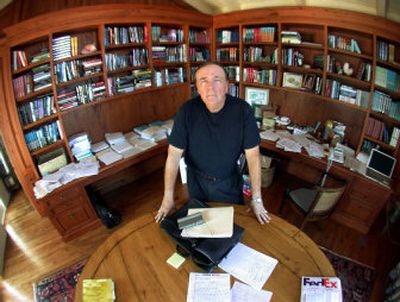
Patterson does most of his writing longhand, in pencil (“Me and Hemingway,” he quips), at a round pine table in a small second-floor office in his home overlooking the Intracoastal Waterway. Some of it he does in bed.
In his writing room, about a dozen neatly stacked piles of works in progress line a desktop.
“We just sold a couple of things to Hollywood – a Cross book, and a horror book for next year,” Patterson says.
“I’m very lucky in that I have kind of the triple-header,” he adds, shaking his head in disbelief.
“I love my little boy, I love my wife and I love what I do.”