
N. Korea key summit topic
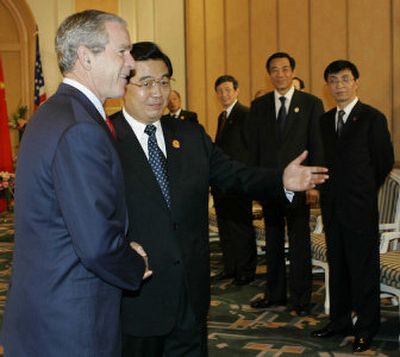
HANOI, Vietnam – Lobbying world leaders, President Bush sought China’s support today for pressuring long-defiant North Korea to prove it is serious about dismantling its nuclear weapons program.
The United States and Russia also signed a key trade agreement – a major economic milestone paving the way for Russia’s entry into the World Trade Organization.
As the largest economy still outside the 149-member WTO, which sets the rules for global trade, the deal with the U.S. is a powerful vote of confidence in Russia’s investment climate.
It also marks a bright spot in the two countries’ relations that have been marred by disagreements over Iran’s controversial nuclear program and Washington’s fears of a roll back of democratic freedoms under Russian President Vladimir Putin.
Bush talked about economic issues and North Korea with Chinese President Hu Jintao. The same subjects were on the agenda later in the day when Bush was to meet with Putin.
“China is a very important nation and the United States believes strongly that by working together we can help solve problems such as North Korea and Iran,” Bush told Hu. Like North Korea, Iran also is suspected of pursuing nuclear weapons.
At a summit of Pacific Rim countries, Bush was consulting individually with leaders of the four other nations engaged with North Korea in nuclear disarmament talks, stalled for more than a year but now on the verge of resumption.
The 21 Asia Pacific Economic Cooperation summit leaders verbally called for North Korea to stop developing nuclear weapons. The group expressed strong concern about North Korea’s nuclear test in October, urged all nations to apply U.S. Security Council sanctions against Pyongyang and called on North Korea to return to the disarmament talks.
Talking with Hu, Bush gently addressed difficult trade disputes between Washington and Beijing. The U.S. trade deficit with China is on its way to easily surpassing last year’s $202 billion record.
“With as much commerce between our countries as there is, there’s going to be trade difficulties,” Bush said, “but nevertheless we both adopt a spirit of mutual respect and the desire to work through our problems for the common good of our peoples.”
Bush applauded Hu for trying to move China into becoming a “nation of consumers and not savers, which will inure to the benefit of our manufacturers, both large and small, and our farmers as well.”
Hu, the host of their meeting, proudly told Bush that trade is expanding between the two countries, referring to reports from the United States showing U.S. exports to China up 35 percent in the first seven months of this year.
In this communist country, Bush made a pointed effort to encourage religious tolerance. He and his wife, Laura, attended services at Cua Bac Church, a concrete basilica built by the French more than a century ago.
Bush said he was pleased to spend a “moment to converse with God. … We were touched by the simplicity and the beauty of the moment. We appreciate very much the congregation for allowing us to come and worship with them.”