
Ecuador candidate stirs U.S. concern
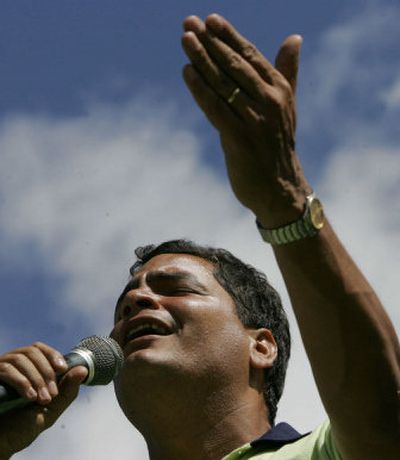
QUITO, Ecuador – Ecuador’s front-runner in Sunday’s presidential election has rattled Wall Street with anti-U.S. rhetoric and nationalist pledges torn from the playbook of Venezuelan President Hugo Chavez.
Rafael Correa’s surge in the polls from a distant third a month ago to first place caused investors to dump Ecuadorean bonds last week amid fears the former economy minister would move the South American nation into a leftist alliance with Cuba, Venezuela and Bolivia.
Both U.S. officials and Chavez – apparently wary of tilting the race with ill-advised comments – have been studiously silent about the rise of the 43-year-old Correa, who last month called President Bush a “tremendously dimwitted” president and vowed to oppose trade talks with Washington.
With 13 presidential candidates competing Sunday, a Nov. 26 runoff election is likely. To win in the first round in Ecuador, a candidate must either get an outright majority of the valid votes, or receive at least 40 percent while the rest of the field trails by at least 10 percentage points.
Forceful and dynamic, Correa has increasingly attracted undecided voters who see him as a fresh face in a field of old-time politicians. But the latest polls show his closest rival – billionaire banana magnate Alvaro Noboa – is gaining as well and now has about 23 percent support to Correa’s 26 percent.
“There’s no way of denying that a Correa victory in the second round would be a very significant assault against Washington’s Latin American policy,” said Larry Birns, director of the Council on Hemispheric Affairs in Washington. “And it would certainly bring in a new recruit for the Chavez bloc at a time when that bloc very much needs one.”
Correa’s candidacy follows that of other Chavez allies, including President Evo Morales of Bolivia, elected last year on a platform of opposing U.S.-backed anti-drug efforts in the region, and Ollanta Humala, the nationalist who came close to winning Peru’s presidency this year.
Birns said the Bush administration doesn’t want to “slam the door in Correa’s face,” or inadvertently help his candidacy with a response that might fuel already strong anti-U.S. sentiment.
For his part, Chavez could hurt Correa’s campaign by openly backing him.
Chavez has been accused of meddling in elections this year in Peru, Mexico and Nicaragua, and “his backing can be the kiss of death to a candidate,” Birns said.
That was the case with Peru’s Humala, who won the most votes this year in the first round but was handily defeated in the June runoff by center-left President Alan Garcia, who adroitly painted his rival as a radical Chavez pawn.
Correa, who has a doctorate in economics from the University of Illinois, opposes resuming stalled free-trade talks with Washington and says he would not extend a treaty scheduled to expire in 2009 that lets the U.S. military use the Manta air base for drug surveillance flights.
He also wants to cut ties to international lending institutions, including the World Bank and the International Monetary Fund, and has threatened a moratorium on foreign debt payments unless foreign bondholders agree to lower Ecuador’s debt service by half.