
Quadruple Vince
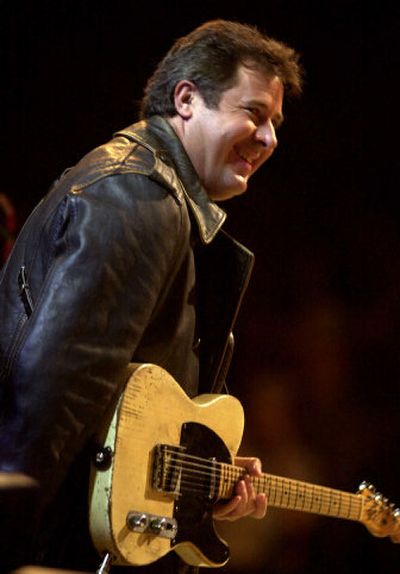

Vince Gill approached his record label last summer with 31 new songs and a wild idea.
Instead of releasing one album of new material, why not three albums staggered over a year?
“I told them before you cut my legs off, just listen to the diversity of all this music,” Gill recalled.
Luke Lewis, chief of Universal Music Group Nashville, not only listened, he did Gill one better: He told the veteran country singer to record a fourth album and MCA Records would put it all out as a four-disc set.
The result, “These Days,” which came out Tuesday, is a throwback in an industry increasingly driven by singles and sensitive about pricing.
Gill wrote or co-wrote all of the 43 tracks, co-produced them, played guitars and assembled a dream team of guests including Sheryl Crow, Bonnie Raitt, Diana Krall, Alison Krauss, Rodney Crowell, Emmylou Harris, Lee Ann Womack, Gretchen Wilson and wife Amy Grant, just to name a few.
The music is diverse, ranging from traditional country and bluegrass to rock, jazz, gospel and pop. The first single on country radio, a ballad with Krauss called “The Reason Why,” recalls 1950s doo-wop.
“It’s not just me singing 43 country songs,” Gill says. “It’s kind of all over the map. And each of the people who came and guested creates a different color, so it’s not just overkill, overkill, overkill with me all the time.”
At 49, Gill is youthful and funny. He’s quick to share a story (ask him how he finally got Raitt on tape after several stops and starts) and even laughs a little about the sheer volume of the project (“I don’t think we bailed on anything.”)
He didn’t set out to make a musical opus. It had been a few years since his last record, and when he finished in the studio, he had three times as much stuff as he needed for an album.
“I went ‘Oh, great. Now what am I going to do?’ ” he says.
“But as I started looking at the songs I realized that if I took this batch here I could make a great traditional country record. And if I took this batch here I could make a record of moody ballads.”
A third batch was uptempo, rock-edged songs.
About that time he was looking at some Beatles memorabilia and noticed that the Fab Four released three albums within the span of a year in the ‘60s.
“I said, ‘Golly, maybe I could do this – put each one out separately, maybe every few months.’ I started doing some homework and thinking about it,” Gill says.
“My theory of sorts was that I’d really like to cater to the fan base that’s been supportive of me over my career. If I put out three records within a few months of each other, more than likely they’d probably buy them all.”
That’s when he went to Lewis, who told him to make the bluegrass-flavored album he’d long wanted to do and release it all as a multi-record concept project – far more common in the heyday groups like The Who and Pink Floyd.
With a suggested retail price of about $30, the package is cheaper than most traditional retrospective box sets but still pricey for many consumers.
“It is risky. Any of this is risky, I guess,” Lewis says.
“But at the end of the day, it’s, ‘Did we lose any money, and is it something to be proud of?’ Well, I don’t worry about losing money on this, and I’m certainly proud to have this on our label.”
“These Days” isn’t unprecedented in scope. The indie rock group Guided by Voices released a four-disc set of new material in 2000, then again in 2005.
Alt-country singer Ryan Adams released three albums of new songs last year, the first of which, “Cold Roses,” was a double set.
“When you give yourself that much room to stretch out, you’ll probably go somewhere you wouldn’t normally go if you were doing a 12-song CD,” says Doyle Davis, co-owner of Grimey’s record store in Nashville. “It shows a side of the artist that might normally be held back.”
Indeed, Gill – highly regarded as an instrumentalist as well as a singer – cut loose on guitar, spiking the songs with rock and blues-laced solos that run longer than on most of his country hits.
His duet with jazz chanteuse Krall, “Faint of Heart,” comes off as a smoky-lounge standard unlike anything in his catalog.
“There are times when we catch these really prolific people on a streak and it seems to me foolish to get in the way of that by being trapped by tradition and conventional wisdom,” Lewis says.
Gill has always been a musical wayfarer. He played bluegrass with Ricky Skaggs, country rock with Harris and Crowell and pop with the Pure Prairie League before becoming a country star in the early ‘90s with hits like “When I Call Your Name” and “Don’t Let Our Love Start Slippin’ Away.”
Later, he recorded with artists as diverse as Barbra Streisand, Mark Knopfler and Gladys Knight.
“I think that’s why I’ve loved him so much through the years. He never was one thing, never let anyone put in him in box,” says LeAnn Rimes, who sings with Gill on the romantic ballad “What You Don’t Say.”
But by 2000 his momentum had stalled. Despite strong reviews, his last album, 2003’s “Next Big Thing,” sold about 290,000 copies – far less than some of his earlier releases – leaving him “a little confused” and “doubting myself a little.”
“I thought ‘Next Big Thing’ was the best record I ever made,” Gill says. “I was going, ‘Hmm, these last couple two or three albums just hadn’t done the deal like in the past.’
“It’s bound to happen, and I’m trying to figure out is it the age I am, is it because of this, because of that. There may not be any reasons, it just is what it is.”
A phone call from rock legend Eric Clapton helped him regain his footing. One of his musical heroes, Clapton invited Gill to perform at his Crossroads guitar festival in 2004.
“He said, ‘I’m inviting only people I admire,’ ” Gill recalls. “And it was just like, ‘Here’s somebody who sees me for what I’ve always wanted to be and have always been – a musician.’
“It inspired me to just play and not worry about the results. Regardless of whether I sold a whole lot or not much, there’s never been a note or a word that’s changed on those records because of the results.
“So it was kind of freeing. It was a big turning point for me.”