Can-do attitudes
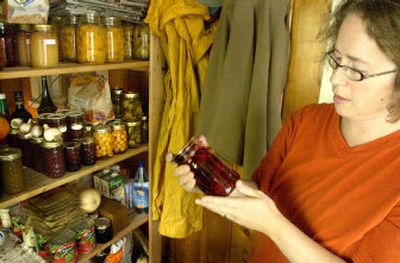
Canning used to be one of the only reliable ways to store perishable foods indefinitely. Home canning was popular in the late 1850s through the middle of the last century, and during that time, the number of jars a woman managed to “put up” in the fall might mean the difference between a long, lean winter or a happy and healthy one.
That might explain why food writer M.F.K. Fisher remembers her grandmother approaching the household duty of canning with “no foolish chitchat.” Men weren’t welcome in her grandmother’s kitchen, and children were generally discouraged.
Still, Fisher, who grew up to be one of America’s greatest food writers, said, “The first thing I remember tasting and then wanting to taste again is the grayish-pink fuzz my grandmother skimmed from a spitting kettle of strawberry jam.” (The Gastronomical Me, 1943).
Like most endeavors that involve the kitchen, I have found that canning can be, at its best, a happy combination of pleasure and necessity, especially when friends and family pitch in to lighten the work.
I watched my mother can applesauce and pickles when I was a child and intended to avoid such work when I was grown up. But now, when the harvest season arrives, my early training kicks in and I take stock of my pantry. Do I need canned prunes this year, or plum jam? Dill pickles or bread and butter pickles? Tomato sauce or salsa?
For the past several years I’ve canned with friends in Kamiah, Idaho, who have apples and Concord grapes in their rental house’s yard. This fall I brought home about four 5-gallon buckets full of luscious ripe grapes and spent time over the course of four days stemming, cooking, straining and canning the juice. My family likes unsweetened grape juice so we drink it straight, and what a treat it is throughout the winter.
Unlike M.F.K. Fisher’s grandmother, I don’t ban men or children from the kitchen. My young son was old enough this year to help with pitting plums and stemming grapes, and I can hope that he’ll grow up, as I did, with an urge to “stock up” in the fall.
Anne Kannegaard, a farmer’s daughter from rural Farmington, Wash., who now lives outside Moscow, Idaho, said she was raised canning with her mother and her sister, and doesn’t even remember a time when she didn’t know how to can.
“It was something we did for sustenance. We needed to. We used to have gardens, and we would prepare all kinds of food every year, all kinds of fruits and vegetables, in large amounts,” Kannegaard recalled.
When Kannegaard was a teenager she spent summers at her married sister’s cattle and wheat ranch near Grand Coulee.
“It was hard work. But I did a lot of canning with my sister while the men were in the fields, and it was fun thing to do together with my sister and with friends, a very social thing.”
Pam Yarwood, who lives on Lake Roosevelt, lived on a 30-acre farm in Michigan for 35 years with her husband and children. She learned how to can on her own, and with her friends.
“We lived in an agricultural area, especially known for fruit. My mother didn’t can when I was growing up, perhaps because buying things at the store was considered ‘modern.’ But I canned because it was the thing to do in the ‘granola generation.’ It was a time of returning to nature, and more a feeling of connecting to the earth than to save money, and a great feeling of accomplishment. All my friends and I did it for our families,” Yarwood said. “I canned pickles, applesauce, peaches, pears, plums, cherries, tomatoes and tomato sauce to last a year and give away at Christmas.”
Some food preservation enthusiasts now do more freezing than canning since it takes less time. Limited freezer space or the prospect of an extended power outage are reason enough to keep alive the art of canning, but for Kannegaard, it’s a matter of taste.
“I do a lot of applesauce from our own trees and a few quarts of peaches because my family loves them,” she said. “I doubt if I’m saving any money by canning but there is nothing like opening up a jar of peaches for a special occasion meal in the winter.”
Canning appeals to conscientious consumers like Kannegaard and Yarwood, who like to know where their food comes from. They also hate wasting food.
“I’m up to my ears in plums and trying to decide how to preserve them,” she said.
Yarwood’s daughter Jordi Kimes now lives with her family on their own 15-acre farm with an orchard in Cashmere, Wash. Last weekend mother and daughter canned more than 70 quarts of peaches and 25 jars of peach jam – most of which will be eaten by Kimes’ family of six.
“Jordi bought the jars and sugar, and I gathered my canning equipment, and went over for a canning bee. Both of us hated the thought of wasting any of those gorgeous big rosy golden peaches, so we canned till we dropped.”
These days, our survival probably doesn’t depend on our ability to stock a pantry full of home-canned produce, but it’s hard to beat the satisfaction of opening up your own jam to spread on a piece of toast, or having a bowl of applesauce from your own apples.
“Canning is labor intensive,” Kannegaard said, “but it’s also a labor of love.”
Canning for beginners
“A new canner needs to hook up with people who know how to do it,” Kannegaard said. “Plus, I use a few books to refresh my memory on occasion.”
Like handling babies and growing a garden, canning is a skill that used to be passed from one generation to another. A budding canner these days, though, might call mom or dad for advice only to discover that they don’t know about food preservation either.
In this case, ask your friends – one of them might turn out to be an experienced canner. Call your local extension agent; he or she will have (or be able to find out) the answers to all your canning questions.
Or, if you prefer the solitary approach, buy yourself a reputable canning book, like the USDA’s Complete Guide to Home Canning and Preserving, or the Ball Blue Book of Preserving. The USDA guide is utilitarian – chock full of information and basic recipes, but lacks panache. The Ball Blue Book, however, has a reputation as the comprehensive go-to guide for people with discriminating palates who love to eat their home-canned food.
Canning is not inherently difficult. It only requires the proper materials (jars, lids, big pan), time, labor, produce and attention to detail. But for beginning canners, the variations, techniques, and difficulties associated with foods like jams and jellies, tomatoes and other vegetables, and meats can be daunting.
How appropriate, then, that one of the earliest “solid” foods fed to babies – applesauce – is also one of the easiest things for a beginning canner to make. Try this ultimate comfort food before moving on to things like pickles or plum butter.
Canned Applesauce
From USDA Complete Guide to Home Canning
An average of 13 1/2 pounds of apples is needed per canner load of 9 pints.
Wash, peel and core apples. Place slices in an 8 to 10 quart pot. Add 1/2 cup water. Stirring occasionally to prevent burning, heat quickly until tender (5 to 20 minutes, depending on maturity and variety). Press through a sieve or food mill, or skip the pressing step if you prefer chunk-style sauce. Sauce may be packed without sugar, or add sugar to taste. Reheat sweetened sauce to boiling. Fill clean, warm jars with hot sauce, leaving 1/2-inch headspace. Wipe jar rims, adjust lids, and process pints in a boiling water bath 20 minutes for altitudes of 1,000 to 3,000 feet.
Low-sugar canning
“Canning is a great way to eat healthy,” Kannegaard said. “I don’t use a lot of sugar because I like the flavor of the fruit to come out. But in the old days they used heavier sugar syrups.”
A little sugar added to the liquid in which fruit is canned does help retain the fruits’ flavor, color, and shape, according to the USDA’s Complete Guide to Home Canning. But the USDA now recommends that a “very light” syrup be used since it contains fewer calories than a heavy syrup.
Most canned fruit, such as apples, peaches, plums and cherries, can be packed in water instead of syrup if desired. Make small batches of fruits and try different ways to learn which you prefer. Vary the flavors a bit by adding a bit of vanilla extract to the syrup, or by tucking a cinnamon stick in the jar with the fruit.
People who love jams and preserves but can’t take all the sugar that normally goes with them can make their own low-sugar jams by using special products that will gel without added sweetener.
Regular pectin requires a sugar content of over 50 percent for jams or jellies to set properly, but “low methoxyl” pectins use calcium as their setting agent. Pomona Pectin is a readily available brand. Inside the box you’ll find a packet of pectin powder derived from citrus peel, and another packet of monocalcium phosphate powder.
When using low-sugar recipes it is very important to follow the directions included with the jelling product. Pomona’s recipe sheet is a little difficult to follow because it has so much information on a small sheet of paper, and it assumes some canning experience. For instance, they won’t tell you what size jars to use, or explain water-bath canning procedures. But they do have a Web site and a “jamline” telephone number (not toll-free) available to help.
The following is one of Pomona’s low-sugar or no-sugar jam recipes.
Low-Sugar Strawberry (or Raspberry or Sour Cherry) Jam
From Pomona Pectin
2 quarts fruit (equal to 4 cups mashed berries)
1/2 to 1 cup honey or 3/4 to 2 cups sugar
2 teaspoons pectin powder
2 teaspoons calcium water
Make calcium water by mixing 1/2 teaspoon calcium powder and 1/2 cup water in a little jar with a lid. (Store in refrigerator between uses.)
Wash jars and sterilize in boiling water for 10 minutes or more; let stand in hot water. Bring lids and rings to boil; turn down heat; let stand in hot water.
Remove hulls from berries, or pit cherries, and mash the fruit. Measure fruit into saucepan. Add 2 teaspoons calcium water to fruit.
Measure sugar or room- temperature honey into separate bowl. Thoroughly mix 2 teaspoons pectin powder into honey or sugar.
Bring fruit to boil. Add pectin-honey or pectin-sugar and stir vigorously 1 to 2 minutes to dissolve pectin. Return to boil and remove from heat.
Fill jars to 1/2 inch of top. Wipe rims clean. Screw on two-piece lids. Put filled jars in boiling water; water level should be at least 1 inch higher than top of jars. Boil for 5 minutes, adding another minute for every 1,000 feet above sea level. (7 1/2 minutes for 2,500 feet.)
Remove jars from water and let cool. Check seals.
Note: This recipe can be made with an equivalent amount of sugar substitute rather than sugar or honey, but modify the recipe as follows. Do not add pectin powder to honey or sugar or sugar substitute. Blend pectin powder in a blender with 3/4 cup boiling water. Add pectin water to boiling fruit. Sugar substitute that can be cooked can be added before the fruit returns to a boil; sugar substitute that can’t be cooked should be added after the fruit returns to a boil. Stir well, fill jars, and process.
Yield: 4 to 5 cups
Approximate nutrition per tablespoon (using 1/2 cup honey): 15 calories, no fat, less than 1 gram protein, 4 grams carbohydrate, no cholesterol, .4 grams dietary fiber, 2 milligrams sodium.
Canned Whole Sweet or Sour Cherries
Save this one for next year’s cherry season. From USDA Complete Guide to Home Canning.
Stem and wash cherries. Remove pits if desired. If pitted, place cherries in water containing ascorbic acid (six 500 milligram vitamin C tablets crushed in a gallon of water) to prevent stem-end discoloration. If canned unpitted, prick skins on opposite sides with a clean needle to prevent splitting. Cherries may be canned in water, apple juice, white grape juice, or sugar syrup. (For a very light syrup, use approximately 3/4 cup sugar to 6 1/2 cups water for a 9-pint canner load. Heat water and sugar together and boil before adding to jars.) Add 1/2 cup hot water, juice or syrup to each jar. Fill jars with drained cherries, shaking down gently as you fill. Add more hot liquid, leaving 1/2-inch headspace. Adjust lids and process in a boiling water bath for 30 minutes at altitudes between 1,000 and 3,000 feet.
Yield: Approximately 11 pounds cherries will yield a canner load of 9 pints
Approximate nutrition per serving: Unable to calculate due to recipe variables.
Canning for gift-giving
Home-canned foods make wonderful gifts for all occasions, especially when you’ve made a special effort to produce something you normally see for big bucks in gourmet groceries. Try handing your hostess a jar of lemon curd, blackberry pie filling, or homemade tomato sauce the next time you go visiting, instead of that same old bottle of cabernet.
Canned Lemon Curd
This recipe can be made any time of year as it uses bottled lemon juice. Perfect for the holidays. From National Center for Home Food Preservation.
2 1/2 cups superfine sugar (see note)
1/2 cup lemon zest (freshly zested), optional
1 cup bottled lemon juice (see note)
3/4 cup unsalted butter, chilled, cut into approximately 3/4-inch pieces
7 large egg yolks
4 large whole eggs
Wash 4 half-pint canning jars with warm, soapy water. Rinse well; keep hot until ready to fill. Prepare canning lids according to manufacturer’s directions.
Fill boiling water canner with enough water to cover the filled jars by 1 to 2 inches. Use a thermometer to preheat the water to 180 degrees by the time filled jars are ready to be added.
Caution: Do not heat the water in the canner to more than 180 degrees Fahrenheit before jars are added. If the water in the canner is too hot when jars are added, the process time will not be long enough. The time it takes for the canner to reach boiling after the jars are added is expected to be 25 to 30 minutes for this product. Process time starts after the water in the canner comes to a full boil over the tops of the jars.
Combine the sugar and lemon zest in a small bowl, stir to mix, and set aside about 30 minutes. Pre-measure the lemon juice and prepare the chilled butter pieces.
Heat water in the bottom pan of the double boiler until it boils gently. The water should not boil vigorously or touch the bottom of the top double boiler pan or bowl in which the curd is to be cooked. Steam produced will be sufficient for the cooking process to occur.
In the top of the double boiler, on the counter top or table, whisk the egg yolks and whole eggs together until thoroughly mixed. Slowly whisk in the sugar and zest, blending until well mixed and smooth. Blend in the lemon juice and then add the butter pieces to the mixture.
Place the top of the double boiler over boiling water in the bottom pan. Stir gently but continuously with a silicone spatula or cooking spoon, to prevent the mixture from sticking to the bottom of the pan. Continue cooking until the mixture reaches a temperature of 170 degrees Fahrenheit. Use a food thermometer to monitor the temperature.
Remove the double boiler pan from the stove and place on a protected surface, such as a dish cloth or towel on the counter top. Continue to stir gently until the curd thickens (about 5 minutes). Strain curd through a mesh strainer into a glass or stainless steel bowl; discard collected zest.
Pour hot strained curd into the clean, hot half-pint jars, leaving 1/2-inch headspace. Remove air bubbles and adjust headspace if needed. Wipe rims of jars with a clean, dampened paper towel; apply two-piece metal canning lids.
Process in the prepared boiling water canner for 20 minutes for altitudes of 1,000 to 6,000 feet. Remove from water and cool, undisturbed, for 12 to 24 hours and check for seals.
Shelf life: For best quality, store in a cool, dark place (away from light). Plan to use canned lemon curd within 3 to 4 months. Browning and/or separation may occur with longer storage; discard any time these changes are observed.
Preparation notes: If superfine sugar is not available, run granulated sugar through a grinder or food processor for 1 minute, let settle, and use in place of superfine sugar. Do not use powdered sugar.
Bottled lemon juice is used to standardize acidity. Fresh lemon juice can vary in acidity and is not recommended.
Variation: For Lime Curd, use the same recipe but substitute 1 cup bottled lime juice and 1/4 cup fresh lime zest for the lemon juice and zest.
Yield: About 3 to 4 half-pint jars
Approximate nutrition per 1-ounce serving: 87 calories, 4 grams fat (2.3 grams saturated, 43 percent fat calories), 1 gram protein, 12 grams carbohydrate, 60 milligrams cholesterol, no dietary fiber, 8 milligrams sodium.
Pam’s Canned Tomato Sauce
From Pam Yarwood (modified to meet USDA standards). The herbs can be fresh or dried. Adjust seasonings to your personal taste. Do not change the amounts of onions, garlic or sugar, or acidity may not be correct for canning.
1/2 bushel ripe tomatoes (about 26 pounds)
5 garlic cloves
3 medium onions, chopped
1/4 cup packed brown sugar
Salt, to taste
1 cup chopped parsley
3 tablespoons oregano leaves
2 tablespoons basil leaves
1 teaspoon black pepper
Lemon juice or citric acid
Cut tomatoes into large chunks, and cook 15 to 30 minutes (with a little bit of water to keep from scorching) until soft, stirring often to evenly cook all chunks. Put through a food mill or sieve to remove skins and seeds. (It’s easy to burn yourself, so be careful.)
Return sieved tomatoes to pot. Add garlic and remaining ingredients and bring to a boil. Reduce heat and cook uncovered 4 hours or so until thick enough. It will reduce in volume almost by half. Check often and stir to prevent scorching.
Prepare jars and lids – washing in very hot water by hand or running through dishwasher and keeping warm until you fill them. To ensure safe acidity, add 1 tablespoon bottled lemon juice or 1/4 teaspoon citric acid to each jar right before filling with sauce. Fill pint jars to within 1/4 inch of top of jar, wipe jar rims, adjust lids, and process in pressure canner. In a dial-gauge canner, process for 20 minutes at 12 pounds, at altitudes of 2,000 to 4,000 feet. In a weighted-gauge canner, process for 20 minutes at 15 pounds for altitudes above 1,000 feet.
Yield: At least 8 pints
Approximate nutrition per 1/2-cup serving: 90 calories, 1 gram fat (no saturated fat, 11 percent fat calories), 3 grams protein, 20 grams carbohydrate, no cholesterol, 4 grams dietary fiber, 900 milligrams sodium.
Canned Blackberry Pie Filling
Save this one for blackberry season next year. From Barry Farm Foods
1 3/4 cup ClearJel (This is modified corn starch. Do not substitute regular corn starch or instant ClearJel, or fruit pectin.)
7 cups sugar
1 teaspoon cinnamon
9 1/3 cups water or juice
1/2 cup lemon juice
6 quarts fresh blackberries
Combine ClearJel, sugar, and cinnamon in a large pan. Add water or juice and lemon juice and mix until smooth. Heat until mixture bubbles, stirring constantly. Add berries and fold in. Remove from heat. Fill clean and hot quart jars leaving 1-inch headspace. Wipe jar rims and adjust lids. Process in boiling water bath 35 minutes for altitudes of 1,000 to 3,000 feet.
Yield: 7 quarts
Approximate nutrition per 1/2-cup serving: 129 calories, less than 1 gram fat (no saturated fat, 2 percent fat calories), .5 grams protein, 33 grams carbohydrate, no cholesterol, 3 grams dietary fiber, 2 milligrams sodium.