
Cultural Celebration
American news media frequently display photographs of Middle Eastern women shrouded in black chadors.
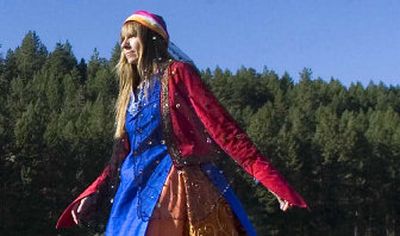
But last week Spokane author Meghan Nuttall Sayres unpacked a box that had just arrived, filled with the clothing of a typical nomadic woman of Iran.
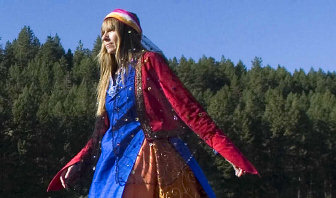
First she pulled out a deep copper underskirt, and then a shimmering overskirt embroidered with gold. She unfurled a long, royal blue, beaded tunic and then a rich pomegranate-colored jacket.
For her hair there was a filmy black veil, a small embroidered cap and a long dyed scarf.
She plans to wear these vividly colored silk and rayon pieces on Friday evening when she presents a celebration of Iranian culture at The Community Building in downtown Spokane.
There she’ll read from her new book, “Anahita’s Woven Riddle,” a young adult novel set in 19th century Iran. There will be a slide show of scenes from that country, Persian carpets, Iranian music and even pistachio cookies.
It’s all designed to help the audience move past assumptions based on those ubiquitous news photos and begin to understand Iranian people and their distinct culture.
“I think when ‘the other’ becomes familiar, they’re not so scary,” Sayres says. “You start seeing them as human beings and not foe.”
This box of women’s clothing, most of it sewn for Sayres by a former Iranian nomad now living in Philadelphia, is just the beginning of the tale.
Sayres, who lives with her family in a stone-covered house in a field south of Spokane, also raises sheep and weaves tapestries on her loom. She has a master’s degree in international rural development and a passion for rural cultures elsewhere around the world.
On a recent afternoon, she poured Turkish apple tea for a visitor and described her impressions of Iranian women.
During a trip to Iran last year, Sayres found that nomadic women wear colorful styles that likely date back to at least the 19th century. She saw children wearing bright colors and drawing pictures of themselves and their families in brilliant hues.
“The children’s mindsets aren’t that they’re wearing black,” Sayres says. “They can imagine they can wear anything. They do wear whatever colors they like.”
The personalities of the people she met were similarly rich.
“They’re not as reserved (as Americans), they don’t hide their emotions, they express love pretty freely,” she says.
Sayres has a number of Iranian friends now living in the U.S., and while in Iran, she met many Iranians as she traveled to a children’s book festival there. She found women were more highly educated and literary than most Americans would imagine. Even the nomads receive library books carried by motorcycles.
She heard children in rural areas debate the merits of studying electrical versus civil engineering, and she saw art displayed prominently in auditoriums and children’s arts institutes.
“They’re worldly,” she says. “It’s not a creatively oppressed nation by any stretch of the imagination.”
Iranians have been particularly excited to learn about her new novel.
It’s the story of a young carpet weaver, a girl who hopes to avoid a traditional arranged marriage by weaving a riddle into her bridal carpet and promising to marry the suitor who can solve it.
Iranians tell her they appreciate the way the novel conveys the nuances of their culture.
“It’s painting a humanitarian picture more than an antagonistic picture of the Mideast,” she says.
The novel began 10 years ago as a short story. Eventually Sayres transformed it into a book, and this month it’s finally been released by Harry N. Abrams in New York.
Sayres has scheduled a series of readings in the area, including one at the Eastern Washington University Women’s Studies Center at noon on Oct. 19, and another at 7 p.m. Nov. 9 at Moran County Library.
Another of her books, “Weaving Tapestry in Rural Ireland,” will be released by Cork University Press in Ireland in November and sold in the U.S. through Dufour Editions. It’s a nonfiction coffee table book combining the oral history, essays and contemporary art of tapestry weavers in Donegal, Ireland.
Sayres, who is also the author of a children’s book called “The Shape of Betts Meadow” (Lerner Books) and a co-author of “Daughters of the Desert” (Skylights Path Press), finds it more interesting to write about foreign cultures than mainstream America. It’s a method of discovery, she says.
“Ten years ago when I started writing this book,” she says, “there were no political issues in the papers daily about Iran. Now there are.”
This fall, as the U.S. considers action against Iran and its nuclear program, she hopes her work opens the eyes of the Americans she meets.
“My biggest fear would be that we would either have air strikes or invade Iran,” she says. “I should hope that more diplomacy and learning about the culture is exercised before any action (is taken).”
She would like for her audiences to walk away with an appreciation of the customs and culture of Iran, and the richness of its people.
The event at The Community Building is also sponsored by Auntie’s Bookstore and Shahrokh “Shawn” Nikfar, host of KYRS-FM’s “The Persian Hour.” Richard Kirishian’s Rugs will provide Persian carpets.
Sayres plans to donate a portion of her book’s proceeds, as well as donations from audience members, to an organization in Iran that helps single women struggling to survive after earthquakes in that country. But her greatest effort is simply to gaze past the fear and the political rhetoric to see the best, most human aspects of life in Iran.
“I feel like at least I’m contributing in some small way to say something positive about people on the other side of the world,” she says.