
Rizzuto beat long odds to become institution
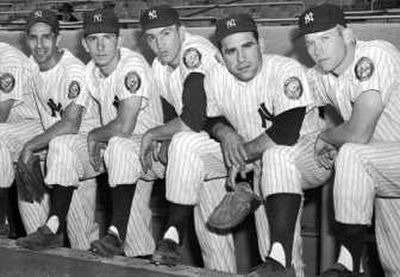
His was the ultimate New York success story, at least in the arena of sports. Before he starred on the diamond at Yankee Stadium and reminded patrons of Ebbets Field and the Polo Grounds how shortsighted were their organizations, long before he became a quirky institution in the broadcasters’ booth, Phil Rizzuto was a regular on the Brooklyn/Queens sandlots.
He served his apprenticeship at Highland Park, Farmers Oval and Victory Field.
As a teenager, he even got the chance to display his talents at Dexter Park, the famous playground of the area’s best semipros. “I played for James Barton’s Nighthawks under an assumed name,” Rizzuto recalled many years later. “I got paid $7 or $7.50 a game. One night we played against Satchel Paige. I remember swinging and hitting the ball. I thought I really pulled it. It dribbled down the first-base line.”
Baseball was all around the city when Rizzuto, who died Monday at 89, was growing to his full height of 5 feet, 6 inches in Ridgewood. Good thing.
“I dread to think what would have happened to me if I didn’t become a ballplayer,” he once confessed. “I certainly was no prize at school.” The lessons he heeded at Richmond Hill High School – “My father was a motorman so I’d get a free ride down Myrtle Avenue” – were confined largely to those offered by Al Kunitz, the baseball coach, who harped on bunting and stealing bases, what we now identify as “small ball.” What could be more appropriate to the shortstop who answered to the nickname Scooter for almost his entire life although, in his later years as the voice of the Yankees, it referred mostly to his obsession for scooting across the George Washington Bridge before the final out.
Failed tryouts with the Dodgers and Giants didn’t discourage him.
They made him work harder until he succeeded in impressing the Yankees.
Still, the odds against him rising through their deep farm system were formidable.
Everywhere he played he was the butt of jokes because of his size, his gullibility and his city-bred discomfort with anything that crawled. The country boys delighted in stuffing the fingers of his glove with worms. He seemed to be afraid of everything, other than hard-throwing pitchers and opposing teams.
The sight of lightning and the sound of thunder terrified him. In his years as a broadcaster, he would occasionally duck under the desk when storms approached, especially in the tornado-conscious Midwest. I remember returning to the Yankees’ hotel in Baltimore after a late dinner with colleagues during the 1970s and hearing the fire-alarm sound as I entered my room. I turned back, took the elevator to the lobby and walked outside, only to find Rizzuto in his pajamas, bathrobe and slippers already standing on the sidewalk.
He was that quick. Even at 60, he posed a challenge in tennis. He could overcome a 25-year disadvantage with a flick of his racket. He featured a variety of cuts, spins and drop shots worthy of Bobby Riggs and he ran his opponents, including yours truly, ragged. It was the same sense of craft that he applied to baseball, that allowed him to overcome physical shortcomings.
He faced other hurdles as a broadcaster. One was his unfamiliarity with tobacco. “Our second sponsor was R.J. Reynolds,” he related. “They didn’t want Mel Allen drinking Ballantine and smoking so I had to do the cigarette commercial live. I’d say, ‘Winston tastes good, like a cigarette should.’ Then I’d light it and start puffing. The card would say, ‘Inhale,’ and as soon as I did, I started coughing. You should have seen the mail. They had to give me a crash course in smoking. We had a five-year contract and I couldn’t wait until it was over.” What was ultimately so endearing about the man was the wide-eyed wonder with which he viewed the world, the basis for the exclamations that amused and entertained “those scoring at home.” It seemed the only way to disturb his good humor was to make a reference to Eddie Stanky, the Giants’ battler who kicked the ball out of Rizzuto’s glove during a tag play in the third game of the 1951 World Series. That was an instance the Scooter never forgot nor forgave.
He got over the snub of Dodgers Manager Casey Stengel to enjoy his best seasons under the Ol’ Perfessor with the Yankees. And he got over the stunning release by general manager George Weiss on Oldtimers Day in 1956 to spend almost four decades behind the microphone for the team he loved. As he noted while preparing for his Hall of Fame induction in 1994, “Life has been wonderful for me.” Personally, I can’t eat a cannoli without thinking of the Scooter.
And I don’t know where huckleberries are harvested but, to me, they’ll always be among New York’s foremost produce.